
Author Liesel K. Hill's Musings on Fantasia...
Showing posts with label Interchron Promo. Show all posts
Showing posts with label Interchron Promo. Show all posts
Monday, February 3, 2014
Tips for an Awesome KDP Promo!
This past month (January) I ran my first real KDP promotions, and they went great!
 The first one I ran was on my book Quantum Entanglement, Book 2 of Interchron. I knew it would be kind of a weird promo, because it's book 2 of the series. Usually you do a book 1 promo. Now, I wouldn't necessarily recommend doing book 2, but my hands were tied here. Book 1 was self-published, which means I can't control the price. Book 2, on the other hand, is self-published. So, I just decided to do a promo on book 2 in the hopes that at least some people would go back and download book 1 and make me some money. (I won't actually know whether or not they did for another week or so, when I get my royalty report from my publisher, so I'll let you know. :D)
Anyway, long story short, I did the promo on Quantum Entanglement, and just didn't expect much. To my shock, 1,328 copies were downloaded over 2 free days. Yippee!
Now, before anyone lectures me, I know that not everyone delves into their free books right away, if at all, and that if anyone does download book 1, the percentage will likely be small.
Yeah, I don't care.

Monday, October 14, 2013
Powers of the Mind and Post-Apocalyptic Worlds: Welcome to Interchron
 |
| Source |
For those who haven't read them, I thought I'd go over the back story of the world they're set in. The world of Interchron is a futuristic, post-apocalyptic one, where society has devoured itself alive with wide-open eyes. Some years in our future, a scientist known only as Smith succeeds in mapping the human brain in it's entirety. What he discovers is that every decision we make as humans, every attribute we take on, everything we observe in any way that influences us, that changes us or otherwise defines us, shows up in our brain chemistry.
 |
| Source |
As people begin to explore and manipulate their brains using these new discoveries, they find ways to develop super-brain powers. Most are mental powers that manipulate neurochemical energy and boost the quality of life. They include things like Healing, Protection through mental shields, and in some rare cases, Time Travel...
Monday, February 11, 2013
Book Trailer, Blog Tour Stops, & Announcements

Happy Monday, Everyone! Just a few quick words and some links here!
If you haven't seen it yet, here's the link to my book trailer for Persistence of Vision. It's short, sweet, and to the point. (Any comments on the narration? Just wondering. :D)
Book Trailer Links: High Res Low Res YouTube

1) Guest Post at Doodle's Book Blog on Why NA over other Genres and
2) Guest Post at Y.A. Storyteller on How it All Began: My Persistence of Vision
Hop on over and see what you think!
Announcements:
1. I will be doing a signing on February 22 in Ogden, Utah at the Hastings store. If you're local, come see me! I'd love to meet you, even if you don't make a purchase!
2. I have several more coming up in March, but I'll put more on those as they get closer.
3. Upcoming Writer's Conferences: LDStorymakers and Indie Recon. Click on links for info. Should both be great so I encourage you to check them out! :D
Monday, November 19, 2012
How to Categorize Dystopia--Which Type Do YOU Prefer?
Announcements and Events:
- I did my first signing on Friday in the building I work in. It's a corporate building that isn't even very fully, but I've worked there for awhile and my co-workers are very supportive of my writing efforts. I signed and sold about 45 books over the space of an eight-hour work day. Squee!
- On December 14-15, I'll be signing and selling books at the South Towne Expo Center's event, Big Bodacious Christmas Boutique. That's in South Jordan, Utah, so if you're close enough! Come see me! I'd love to meet some of my followers and blogger buddies in person! :D
Now onto today's post:
Categorizing Dystopia
In my experience, there are two kinds of dystopian stories: the kind that ends well, and the kind that doesn't.
Now, hear me out. I know this can be said of all types of stories, but it's particularly relevant to dystopias. Why? Dystopias are inherently political. They always have an agenda--even more than science fiction does.
Lee Konstantinou of LA Review of Books wrote an excellent article about this entitled, "When Scifi Went Mainstream." This article is what got me thinking about this, so I encourage everyone to check it out.
Because dystopian stories always show us an undesireable society and serve as a warning to us to not let our society get to that point, authors can handle it one of two ways:
1) They can start in an undesirable way and end up better than they started, creating a dynamic society.
or
2) They can start with an undesirable society and end up the same way.
Let's talk about each of these options.
| tumblr.com |
Now, I'm going to say something that may be a bit controversial, but I appeal to Konstantinou's article to back me up: this kind of dystopian is not classic dystopian. This is a modern mutation: the melding of dystopian and the action/adventure genre. Traditional dystopian was largely literary, but more on this in a minute.
| guardian.co.uk |
The second type of dystopia is when the society, though undesirable, remains unchanged. The characters may change, but they don't have the strength or resources to change their society for the better. Examples of this would be Kazuo Ishiguro's Never Let Me Go (saddest story EVER!) and Cormac McCarthy's The Road. In these stories, the characters are dynamic and undergo their own kinds of transitions, but in the end, they are subject to the worlds they live in, and there's nothing they can do about it.
| amazon.com |
Which is not to say that I necessarily prefer it myself. Though I am very affected by it, I'm a sucker for a (at least mostly) happy ending just like everyone else. :D
This second type tends to be much more literary than the first type, so I suppose you could categorize these as 1) Literary Dystopian, which would be character driven and probably not have a happy ending, and 2) Commerical Dystopian, which would be revolution (and therefore plot) driven, and probably end well. These are broad categories, of course, but relatively correct just the same.
What do you think? Is literary dystopia more effective than commercial? Which do you prefer?

In a world where collective hives are enslaving the population and individuals have been hunted to the verge of extinction, Maggie Harper, and independent 21st Century woman, must find the strength to preserve the freedom of the future, but without the aid of her memories.
After experiencing a traumatic time loss, Maggie is plagued by a barrage of images she can't explain. When she's attacked by a creep with a spider's web tattoo, she is saved by Marcus, a man she's never met, but somehow remembers. He tells her that both he and her creepy attacker are from a future in which individuals are being murdered by collectives, and Marcus is part of the rebellion. The collectives have acquired time travel and they plan to enslave the human race throughout all of history. The flashes Maggie has been seeing are echoes of lost memories, and the information buried deep within them is instrumental in defeating the collective hives.
In order to preserve the individuality of mankind, Maggie must try to re-discover stolen memories, re-kindle friendships she has no recollection of, and wade through her feelings for the mysterious Marcus, all while dodging the tattooed assassins the collectives keep sending her way.
If Maggie can't fill the holes in her memory and find the answers to stop the collectives, the world both in her time and in all ages past and future will be doomed to enslavement in the grey, mediocre collectives. As the danger swirls around her and the collectives close in, Maggie realizes she must make a choice: stand out or fade away...
Releases nationwide on January 29, 2013!
Monday, September 10, 2012
6 Elements of a Great Dystopia
So my forthcoming book falls under the heading of Dystopian Fantasy. Dystopia is a hot genre these days because of the success of things like The Hunger Games and the bounce-back of the zombie genre (just one great big dystopian world. See my earlier blog post where I discuss this.)
So I got to thinking: what elements make a great dystopian world? There are a few
1) The government/ruling entity must be supremely powerful. As in, no one defies them. No one gets out. Penalties for rebellion are beyond severe. You must convince your reader of the danger your MC will be in if they dare defy the powers-that-be. The darker, more brutal, more mysterious, the better! Ever notice how no one cares if someone defies the PTA. (Okay, maybe the PTA moms.) Make your governing entity intimidating, please! These are the kinds of people that kill without thought, torture without conscience, suppress basic human rights, and kill liberty. Make your readers hate them!
2) You dystopic world itself must be dangerous! Again, if your MC is in danger of stubbing his/her toe while crossing the road, no one's going to be impressed. Long before the Hunger Games commenced (before the Reaping, even) Katniss took risks by venturing outside permitted areas. In Cormac McCarthy's pulitzer-prize winning The Road (a MUST read if you're at all into dystopia), life is dangerous. The man can't go certain places, do certain things. He must keep going; he must keep his son alive; they can't stay in one place for more than a night or two. We don't even know why, only that there's an inherent sense of danger. These worlds are deadly. Make your reader feel it.
3) Darkness and gloom. The Hunger Games didn't make use of this one, except perhaps in describing District 13, but it's often a good idea to have things like overcast skies and barren landscapes. Think the "real world" shown in The Matrix. In The Road, we aren't given details about what event threw the world into madness but McCarthy's description of ashes in the air points to some kind of extinction-level-event that resulted in nuclear winter. This one may not be a must-have, but it's a good way to go. Even if your world isn't this way physically, using these kinds of words as mood-descriptors will help make your world FEEL very dystopian. If you need inspiration, may I suggest listening to New Divide by Linkin Park. The imagery in this song is very post-apocalyptic. (Might I add that I'm currently writing Book 2 of Interchron, and the 2nd verse of this song inspired the ending. Just sayin'. Click the link if you're curious!)
4) Facades. Of course you don't want to confuse your reader, so don't go overboard, but in my opinion, the more, the better. You could do any number of these, but here's a few examples that it's a good idea to include.
5) Tragedy. There simply MUST be tragedy in a dystopic world. I recently watched the movie version of The Hunger Games with my younger sister, who'd never seen it before. While my sister can get weepy, especially where her daughter is concerned, she's not one to sit back and cry very often or feel sorry for herself. She often says (and The Hunger Games was no exception) "Don't get sad, get pissed!" I think this describes very well how dystopic stories work. Tragedy or sadness is a powerful emotion, perhaps the most powerful one we have. Look at how depressed people behave (or don't) or how the death of a child or other loved one effects us. Tragedy is what moves people to action. I think Suzanne Collins did this masterfully. The death of a certain child or children (trying to stay away from spoilers here) is what sparked revolution in the districts. Only tragedy can have that sort of effect. So, set down the rules of your world, show the conflict, then add some tragedy. You'll be amazed how fast your characters will form insurrections and take their lives into their own hands.
So I got to thinking: what elements make a great dystopian world? There are a few
 |
| Source: collider.com |
 |
| Source: cache.io9.com |
 |
| Source: thegospelcoalition.org |
4) Facades. Of course you don't want to confuse your reader, so don't go overboard, but in my opinion, the more, the better. You could do any number of these, but here's a few examples that it's a good idea to include.
- Illusion of a perfect world--the way the ruling entity is keeping power is by putting forth the idea that their rule of the world is perfect. Even if the citizens of your dystopia know better, perhaps they see this as the lesser of two evils. So there should be a very distinct line between what the world seems to be and what it actually is.
- Mystery of the ruling entity. There should be many things about the unrighteous, ruling entity that are not readily obvious to it's citizens. Slowly revealing shadowy truths about your ruling entity will keep the story moving forward and eventually show the reader how the evil entity will be brought down. If you wanted to bring down a government, how would you go about it? Rush the capital on a motorcycle? Good luck in prison, pal! On the other hand, if your characters (and therefore your readers) can slowly, piece by piece infiltrate the entity and find it's weaknesses, well...
- Character facades. Anyone know what synectoche is? It's a really geeky English major word that means a smaller story mirrors events in a larger one. A play within a play, if you will, but events in the two stories mirror one another. The best example of this EVER was Lost, which isn't on anymore, but they did this beautifully. Anyway, because facades are just part of dystopia, utilizing them with your characters is a great way to mirror the larger story and keep tension. Just make sure to reveal all truths by the end (of the story, not necessarily the novel) so the reader feels satisfied.
- I'm sure there are many other possibilities. This is something you could play around with and never entirely miss. Like I said, the more, the better.
 |
| Source: Goodreads |
6) Hope.This goes hand-in-hand with #5, but make sure there is some hope. I've read some stories that are nothing but depression and hopelessness from beginning to end. The point of these stories was shock value and to show that we need not to let our world become that way. I understand the point, but I don't necessarily agree with it. You send a much more powerful message, tell a much more powerful story, when you give your readers strong characters who have some chance of bringing down the system. Who didn't want to tune in and see if Katniss prevailed? I simply couldn't stop reading The Road. It was actually quite tragic throughout, but the MC had a plan, a mission, something he had to do that propelled him on. I HAD to keep reading to see if he succeeded. Hope will propel the reader on to the next scene, the next chapter, the next book.
There may be more elements to good dystopias, but I think the majority fall under one of these settings. If you write a good dystopia, people will return time and again to see how your MCs fair.
What do you think? What elements do YOU think make a great dystopia?
In a world where collective hives are enslaving the population and individuals have been hunted to the verge of extinction, Maggie Harper, and independent 21st Century woman, must find the strength to preserve the freedom of the future, but without the aid of her memories.
Coming Winter 2012

After experiencing a traumatic time loss, Maggie is plagued by a barrage of images she can't explain. When she's attacked by a creep with a spider's web tattoo, she is saved by Marcus, a man she's never met, but somehow remembers. He tells her that both he and her creepy attacker are from a future in which individuals are being murdered by collectives, and Marcus is part of the rebellion. The collectives have acquired time travel and they plan to enslave the human race throughout all of history. The flashes Maggie has been seeing are echoes of lost memories, and the information buried deep within them is instrumental in defeating the collective hives.
In order to preserve the individuality of mankind, Maggie must try to re-discover stolen memories, re-kindle friendships she has no recollection of, and wade through her feelings for the mysterious Marcus, all while dodging the tattooed assassins the collectives keep sending her way.
If Maggie can't fill the holes in her memory and find the answers to stop the collectives, the world both in her time and in all ages past and future will be doomed to enslavement in the grey, mediocre collectives. As the danger swirls around her and the collectives close in, Maggie realizes she must make a choice: stand out or fade away...
Monday, September 3, 2012
Three Things to Consider This Labor Day! Plus RMQ!
Good Monday, everyone! Happy Labor Day! I'm sure everyone's bright-eyed and bushy-tailed today! :D
The first two things are just announcements. The third has to do with deeper thoughts! Consider this:
1) My cover.
Giselle of Xpresso Reads featured my book's cover on her FB page on Sunday. If you could take a minute to click the link and "like" her post, I'd really appreciate it! :D Going along with that, I'm currently setting up other cover reveals so you'll see my book's cover around a bit more. Keep an eye out for it!
2) Dragons
My second announcement is probably more exciting for me than for you, but I finally started writing my high fantasy project. (Yea!) On Sunday morning I wrote the first chapter. It was exciting to finally begin writing it, especially as it was the first time I've written something new and original in about a month. I've been busy editing and moving to a new apartment, so my treasured writing time has kind of disappeared. It's so great to get back on track. And remember, this new story features dragons! :D
3) Memories
Okay, so let's briefly talk about memories. How important are memories in our lives? I think we can all agree: VERY!
Our memories define who we are...to ourselves. Other people define us by what their five senses tell them and by what they know of us, but without memories, how are we to know ourselves?
But what if you lost a year of your memories? What if you found out that during that year you made friends, went on important missions, and fell in love...and now you remembered none of it? What if you could never reclaim those memories? What if the reason for the memory loss...was your fault?
 Persistence of Vision, coming winter, 2012.
Happy Labor Day everyone! :D
So the RMQ from Friday was:
"Did you see that? She stole that tie! It's a perfect crime. Girls don't wear ties!"
"Yes, if she murdered the tie it would be a perfect crime."
No one guessed this one. It's from an old movie starring Dudley Moore called Arthur. They recently did a (somewhat hokey, but still entertaining) remake with Russell Brand. The first line was said by Dudley Moore, as Arthur, a rich, lovable playboy millionaire. The second was said by the wonderful John Gilgud, as Hobson, his butler. :D
My parents quoted this line ALL THE TIME when I was a kid. I could quote the line long before I ever saw the movie!
Now for today's RMQ: (slightly easier)
Who said it? One point for film (be specific!), one for character, one for actor...Go!
The first two things are just announcements. The third has to do with deeper thoughts! Consider this:
1) My cover.
Giselle of Xpresso Reads featured my book's cover on her FB page on Sunday. If you could take a minute to click the link and "like" her post, I'd really appreciate it! :D Going along with that, I'm currently setting up other cover reveals so you'll see my book's cover around a bit more. Keep an eye out for it!
 |
| Source: Fanpop.com |
My second announcement is probably more exciting for me than for you, but I finally started writing my high fantasy project. (Yea!) On Sunday morning I wrote the first chapter. It was exciting to finally begin writing it, especially as it was the first time I've written something new and original in about a month. I've been busy editing and moving to a new apartment, so my treasured writing time has kind of disappeared. It's so great to get back on track. And remember, this new story features dragons! :D
3) Memories
Okay, so let's briefly talk about memories. How important are memories in our lives? I think we can all agree: VERY!
Our memories define who we are...to ourselves. Other people define us by what their five senses tell them and by what they know of us, but without memories, how are we to know ourselves?
"Memories are intensely personal things...they're like rivers of identity that seep into the pores of your soul."
--The Remembrancer, Persistence of Vision
But what if you lost a year of your memories? What if you found out that during that year you made friends, went on important missions, and fell in love...and now you remembered none of it? What if you could never reclaim those memories? What if the reason for the memory loss...was your fault?

Happy Labor Day everyone! :D
Random Movie Quotes (RMQ)
Don't know what this is? Click here.
So the RMQ from Friday was:
"Did you see that? She stole that tie! It's a perfect crime. Girls don't wear ties!"
"Yes, if she murdered the tie it would be a perfect crime."
No one guessed this one. It's from an old movie starring Dudley Moore called Arthur. They recently did a (somewhat hokey, but still entertaining) remake with Russell Brand. The first line was said by Dudley Moore, as Arthur, a rich, lovable playboy millionaire. The second was said by the wonderful John Gilgud, as Hobson, his butler. :D
My parents quoted this line ALL THE TIME when I was a kid. I could quote the line long before I ever saw the movie!
Now for today's RMQ: (slightly easier)
"Where HAVE you been? Bed's empty...no note...car gone. You could have died! You could have been seen!"
Who said it? One point for film (be specific!), one for character, one for actor...Go!
Wednesday, August 22, 2012
Best Villains of All Time--Part 2
"Villainy that is vigilant will be an overmatch for virtue, if she slumber at her post."--Charles Caleb Colton
Hello everyone! So last week I did a post called Best Villains of All Time. Here, I'm doing part 2 of my villains series.
Today, we'll be talking about secondary villains and next week we'll address comedic villains. (My terms. You won't find them on wikipedia.)
A secondary villain, by my definition, is a villain that follows the primary villain around. In other words, storm troopers (star wars), orcs and goblins (LOTR), and various monsters and villains in other stories. Basically, secondary villains are the grunt guys or sidekicks to the main villain.
While your primary baddies need to be almost, if not entirely as well rounded as your heroes, your secondary villains really shouldn't be. In fact, you should make them pretty flat. By all means make them evil, intimidating, etc., but if you go into a back story with them, it will take away from your primary villain.

So, make your secondary villains one-sided. In my story, Persistence of Vision, due out the end of this year, I have two types of secondary villains. They're called Arachnimen (so named for the spider's web tattoo on their face) and Trepids. They're more or less the same thing except that Trepids are higher in the hierarchy of evil.
These guys are basically just big stupid brutes. They take orders from the collectives and go around doing the rape, pillage and plunder thing. They rarely make their own decisions, and aren't at all independent. I do have main bad guy which the reader is only briefly introduced to in Book 1, but it's enough to know that, while the Arachnimen and Trepids are capable of doing some damage, they aren't the real threat. And they're definitely not the brains of the operation.
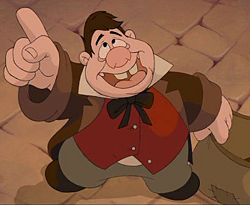
As long as you have a well-rounded primary villain to pit against your hero/heroine, secondary villains, while not great characters themselves, can definitely be an asset to your story! Try one out sometime! :D
Random Movie Quotes
Don't know what this is? Click here.

The film is called The Neverending Story. The line (very tragic) was said by Rock Biter. Both of these were guessed first by The Housework Can Wait. So two points there! Great job! No one guessed the name of the actor that played him. His name was Alan Oppenheimer and he also did voices for Falcor, G'mork, and the Narrator. (Just a bit of totally useless trivia for you! :D) Thanks to everyone who participated! Great job!
Now, onto today's RMQ!
"There are no happy endings, because nothing ends."
Again, three points possible. One for the name of the film, one for the name of character who says the line, and one for the name of the actor. Good luck! :D
Monday, August 20, 2012
Five Reasons You WANT to Be Drugged in Vegas
1) Despite a year of agony, trying to figure out what went wrong and what happened to you during your lost time, a year later a hot guy may show up to tell you he's from the future and that he desperately needs your help.
2) You'll get to Travel through time and get a glimpse of the earth's future.
3) You'll get to learn the history of things to come and meet a team of individuals who are fighting for the freedom of humanity.
4) The team will teach you how to use your super-brain powers, including unparalleled Offensive energy.
5) You may fall in love with the brooding, serious team Healer, who remembers you and knows you personally, though you don't remember him at all. (Okay, maybe that would be less than pleasant, but still...)
Yeah, you definitely want to get drugged in Vegas...
Persistence of Vision--Slated for release winter 2012.
2) You'll get to Travel through time and get a glimpse of the earth's future.
3) You'll get to learn the history of things to come and meet a team of individuals who are fighting for the freedom of humanity.
4) The team will teach you how to use your super-brain powers, including unparalleled Offensive energy.
5) You may fall in love with the brooding, serious team Healer, who remembers you and knows you personally, though you don't remember him at all. (Okay, maybe that would be less than pleasant, but still...)
 |
| Stand out or fade away... |
Persistence of Vision--Slated for release winter 2012.
Monday, August 13, 2012
Stand Out or Fade Away--What Would You Do?
Okay, so loaded question: stand out or fade away?
Let's say some kind of dire situation takes place in the world. You know, aliens invade, there's a nuclear holocaust, WWIII (with WMDs, EMPs, and lots of other fun, civilization-annihilating weapons, of course) or some other as yet unforeseen disaster takes place.Then let's say, in the post-apocalyptic aftermath, with hundreds of vacant cities, millions of unburied bodies, and roving gangs as the only poor substitute for law and order, you stumble upon a way to keep yourself and your surviving loved ones safe. This thing would give you security, protection, and even help to push away the heartache of the world.
It would make living, moving forward, getting out of bed in the morning, easier. It would mean the hole in your chest and the ache in your gut, put there by the things and people you've lost and know you can never regain, will finally feel better. You're heart might even feel light again.
Would you do this thing?
Of course you would! Why not?
Well, there's a catch.
This thing you can do is to become part of a collective, to link your mind to hundreds of others, "like so many lines of needlework." And what is the down side?
Loss of individuality.
Your emotional hurts may be tempered, but that doesn't mean they'll heal. Your emotions will be greatly mediated, but at what cost?
So what, you say. I'll receive safety, security, a community of hundreds of minds working together. That can't be bad, right?

What would you choose? Security in a terrifying world, or individuality?
Stand out, or fade away...?
Persistence of Vision, Book 1 of Interchron. Winter, 2012.
Subscribe to:
Posts
(
Atom
)