
Author Liesel K. Hill's Musings on Fantasia...
Showing posts with label Villains. Show all posts
Showing posts with label Villains. Show all posts
Monday, September 5, 2016
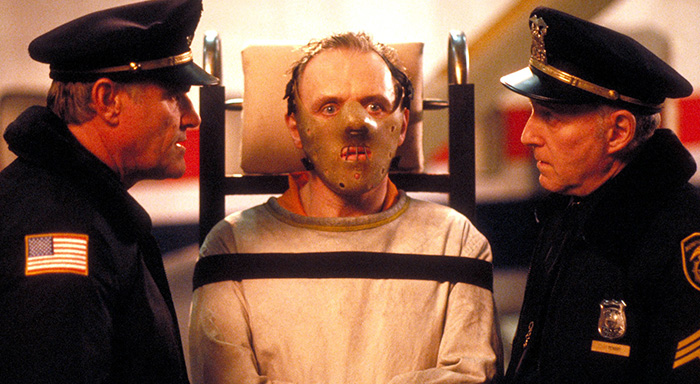
Why Do Serial Killers Fascinate Us So?
 |
| Source |
So today my post is actually HERE, over at Author Fiona Mitchell's blog. She's hosting me in anticipation of Desolate Mantle being released next week. So hop on over to her blog to read the post, and be sure to thank her for hosting me while you're there. She's awesome, and a very gifted writer.
Desolate Mantle: Release Date 9/13/2016
Click HERE to attend the online launch party, or for more information.


In the most dangerous city in the country, one controlled by the sadistic Sons of Ares gang, Kyra Roberts recently crossed paths with detective Gabe Nichols. She dismissed any liaison with him as impossible, but telling him the truth may prove inevitable...Walking the Slip Mire nightly, dressed in her disguise and trying to infiltrate a homicidal gang, Kyra sees plenty of things she can’t explain. When she begins to suspect a serial killer might be at work, she decides to approach Gabe again.Gabe has plenty to keep him busy: a bizarre missing persons case, a new development in his brother’s cold case, a new neighbor, and the grisly murders that are a nightly ritual in the Slip Mire. When Kyra shows up unexpectedly, he jumps at the chance keep her around, but it’s harder than he bargained for. She’s not an average source any more than she’s an average Mireling. Gabe wishes she would be sensible about her own safety.Their partnership crumbles, but when things become even darker than usual in the Slip Mire, they’ll need one another get survive a hellish situation. If they can’t work together to shoulder their burdens, they’ll find themselves utterly alone. In Abstreuse, it’s not a matter of not coming out of the darkness, but of being absorbed by the darkness itself…
Happy Monday, Everyone!

Thursday, February 26, 2015
3 Things You MUST Remember When Establishing a Villain's Arc
 |
| Source |
So, here are three things every writer MUST consider when planning a villain's character arc.
1. Villain Psychology -- Here's the thing about villains. They actually want all the same things as heroes and regular people who don't engage in evil and/or douche-baggery. They want love, happiness, peace, justice, etc. The major difference is that villains, unlike heroes, no longer have the hope that they can obtain these things. They have a very negative outlook on the world, so they try to force people to give them these things in various, nefarious ways (i.e. violence, deceit, scheming, etc.)
Another thing to keep in mind is that, despite all their swagger, pride, self-confidence, etc., at their core, they actually have very low self-esteem, a very negative outlook on life and, more often than not, they hate themselves. The more evil your villain is, the more deep their self-hatred. That's important. If a person truly has awesome self-esteem and self-love, they don't feel the need to dominate and hurt others.
(Keep in mind that the villain will generally not admit any of this, even to themselves. They themselves may not realize this. Also, none of this nullifies their free will. They still have to be held accountable for their actions, but it's important to understand their psychology.)
 |
| Source |
For example, your villain may want money, revenge, power, world domination, etc. That's his or her tangible OOD. But the one I want to talk about that most writers fail to take into account is the intangible OOD. So what is it for a villain?
As I said above, it's really the same as for heroes, at least up to a point. But here's the rub: really bad villains can reach a point where they no longer want those good things. They no longer want to be saved. They can get to a point where they hate themselves so much, they wish for annihilation.
I started thinking about this while re-reading Robert Jordan and Brandon Sanderson's A Memory of Light. Check out this line:
Rand (good guy): "If my victory is not assured, neither is your fall. Let me pass. For once, make the choice you know you should."Keep this in mind when crafting your villains. Of course redemption is always a possibility, but the more evil they are, the more likely they have given up on redemption all together and wish only to be nothing.
Moridin (really bad guy): "Now? Now you beg me to return to the light? I have been promised oblivion. Finally, nothing, a destruction of my entire being. An end. You will not steal that from me...By my grave, you will not!"
3. The Arc and Where They Are On It

On the left of this arc is a villain who actually borders on good. You'll find people like anti-heroes and very sympathetic villains here. Their motivations might change throughout the story to where we hardly consider them villains anymore at all.
On the right are the really far-gone bad guys. We're talking Mister Kurtz (Joseph Conrad's Heart of Darkness), Hannibal Lector, and other seriously evil baddies who are nowhere near redemption. Quite the opposite.
When planning your villain, place them somewhere on this arc. Do they still have a great hope of redemption? Are they too far gone to want anything but oblivion? Are they somewhere in the middle, straddling the precipice between the two?
What do you think of the Villain OOD Arc?
Monday, August 18, 2014
The 10 Kinds of Villains and How They Can Deepen Your Story

It's been a while since I did a post on villains, but the above picture is one of my faves from Pinterest and it makes me laugh every time I see it. I hope you've all seen enough of the featured villains to appreciate the humor. It got me thinking about different kinds of villains and the different roles they can play in a story. As an author, you don't want to do the same kind of villain all the time. Changing it up can add depth and variety to your plot, pulling your readers into it even more efficiently. Which is pretty much the whole point.
Monday, July 29, 2013
Portrait of a Adolf Hitler: 9 Way s to Make Your Villains More Unbalanced (and Creepier!)
 |
| Source |
A while ago, I was looking for information on Hilter's "carpet chewing" fits and came across a document about Hitler's temperament, based on reports of people who knew and worked with him. (All quotes from this source.) There are some really interesting aspects of his personality. None of them are at all admirable, but I think they could be great things to incorporate into a villain's character sketch.
1. Not forward-thinking or hard working.
"He is unable to maintain any kind of a working schedule...In later years the hours tended to get later and it was unusual, just before the war, for him to go to bed before daybreak. The night, however, was not spent in working as his propaganda agents allege, but in viewing one or two feature movies, endless newsreels, listening to music, entertaining film stars or just sitting around chatting with his staff."
2. Afraid of the dark.
1. Not forward-thinking or hard working.
"He is unable to maintain any kind of a working schedule...In later years the hours tended to get later and it was unusual, just before the war, for him to go to bed before daybreak. The night, however, was not spent in working as his propaganda agents allege, but in viewing one or two feature movies, endless newsreels, listening to music, entertaining film stars or just sitting around chatting with his staff."
2. Afraid of the dark.
Wednesday, September 5, 2012
Best Villains of All Time--Part 3
"Oh villain, villain, smiling, damned villain!
My tables--meet it is that I set it down
That one may smile, and smile and be a villain--"
--Shakespeare, HamletSorry it's taken me so long to get to the final installment of this series! I've had a busy couple of weeks and I haven't been able to devote as much time to my blogs as usual. Back on track now, though.
My first post was about primary villains. The second was about secondary villains. For the final installment of my villains series, I want to talk about the comedic and/or comedy villain! This is something that, in my opinion, can be a fascinating character study, but is not done very often, or at least is not done very well.
Let me explain what I mean by these terms. The place I found the best definition is called Villains Wiki. It states the following:
Comedic Villains are evil characters who are shown to have a sense of humor, usually a rather dark one, and express it while they do their evil doings. This is not to be confused with the Comedy Villain, as although there is a massive overlap, the difference is that while a "Comedy Villain" is any that is intended to be funny to the viewer, even if they take themselves completely seriously within the story itself (where they would be funny due to their unintentional ineptitude and/or the general absurdity of a ridiculous story), the "Comedic Villain" is defined by the character him/herself having a deliberate sense of humor and making jokes within the story itself. A particularly dark variety of this, where the villain in question is not a "Comedy Villain", is a "Comedic" villain who performs truly heinous acts such as murder and torture, but jokes about them as if they were much less serious, demonstrating an insensitivity to the severity of their own actions and/or general insanity.
So what are some examples?
Understand that, almost by definition, such villains will never be dynamic. He or she will start out evil and end up evil, too. The audience's fascination comes from his humor and the fact that he's totally evil, but makes them laugh. They don't root for him. They totally hope the hero/ine gets to kill him in the end, but they like watching the villain nonetheless. This kind of villain is perfect for the description, 'you love to hate him.'
The Bad:
 |
| Source: rottentomatoes.com |
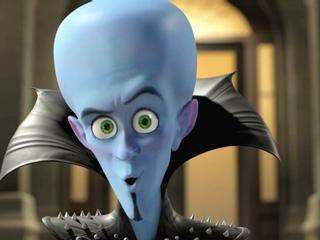
Okay, I know there are a lot of people who like this movie, so try not to be offended that I put it on the bad list. I actually haven't even seen all of it. The reason I put it on my bad list is that I know this film didn't do very well critically or at the box office. When I watched some of it (mostly just the ending) I understood why. This film was sold (by it's trailer) as being a good vs. bad superhero cartoon. Yet, by the end, Megamind (apparently the bad guy) converts over to being the good guy, saves the world and gets the girl. I'm not even sure what happens to the superhero-good-guy. I think at some point Megamind kills him. Now, this isn't bad in itself, but it's not what people were expecting, based on the trailer. I think audiences were mostly just disappointed. Why? By choosing to end the movie this way, they completely undermined the villain. Don't do this with your villains! At least, not the comedic ones. As we've already discussed, they need to remain evil for the most part!
I know, I know. Some of you are going to point your finger at me and scream Star Wars. And you have a point. But it's still a different situation. Granted, Vader turned good at the end, but it didn't matter. 1) By then there was a well-established eviler villain (the emperor), and 2)his turning in no way diminished his villain status throughout the rest of the franchise. He was so firmly ingrained in our minds as a villain, that it didn't matter. Now, understand that it took three movies, many years and possibly the largest movie franchise in history to make him that way. So, if this is a short story or stand alone movie or novel that isn't well-established in pop culture and you try to do this, it's going to fall flat with audiences. Sorry folks. Just the way it is. Furthermore, Darth Vader wasn't a comedy/comedic villain, so he gets a free pass anyway.
 |
| Source: chasingthefrog.com |
Bad Batman Flicks
 |
| Source: batman.wikia.com |
If your villain spends the entire story running around laughing hysterically at jokes only he understands and thinks are funny, you're going to lose your audience pretty quickly. Granted, they'll be creeped out, but after about five minutes they're going to want more and if they don't get it, your villain will be labelled as stupid. This has happened way too often in the past with comic book villains!
Robin Hood Villains
The villains in Robin Hood have been done so many times and in so many ways that I could go on and on about them. (Don't worry, I won't.) One that was handled poorly is the tiara-wearing King John of the 1973 Disney Cartoon. This villain was whiny, immature, babyish, and just plain annoying. Granted that may partially be because he was the villain of a children's cartoon, but still. I can't help but wonder if the decision to make him that way was politically motivated--1970s and all.
The Good:
All right! Enough with the bad! Let's talk about when this type of villain has been done well!
First--you knew I was going here!--Heath Ledger's the Joker. Yup, that's right! This villain was good enough to make it into two out of three of these posts. Ledger gave us the ultimate comedic villain. He was all kinds of evil and we couldn't wait for Batman to beat him. His laugh was just maniacal enough to go straight to our spines, but he made just enough sense to freak us out. He did aforementioned maniacal laugh while performing evil deeds, but took himself completely seriously. He was just as evil and crazy at the end of the film as he was at the beginning.
I read somewhere that in the famous scene in the jail where the mayor names Detective Gordon as Commissioner, Gary Oldman was freaked out. In the movie, we see the Joker applauding in an over-the-top, ridiculous way while the new Commissioner's co-workers cheer him on. Gary Oldman said that the Joker applauding was not in the script. Ledger just did that because he was so in character. Now, most of us in the audience laughed at that, and Oldman has done a good few villainy roles and been pretty dang good at them, but when he turned around and saw Ledger doing that he went, "Whoa. That's kind of creepy." That says a lot.
 |
| Source: aveleyman.com |
To this day, this is one of my all-time favorite movies. Alan Rickman's performance may not be the ONLY reason for that (the medieval setting and awesome romance couldn't possibly have anything to do with it *averts eyes*) but he's definitely a big part of it.
I hope someday to be able to create a memorable comedic or comedy villain.
What do you think? Who are your favorite comedy/comedic villains?
Wednesday, August 22, 2012
Best Villains of All Time--Part 2
"Villainy that is vigilant will be an overmatch for virtue, if she slumber at her post."--Charles Caleb Colton
Hello everyone! So last week I did a post called Best Villains of All Time. Here, I'm doing part 2 of my villains series.
Today, we'll be talking about secondary villains and next week we'll address comedic villains. (My terms. You won't find them on wikipedia.)
A secondary villain, by my definition, is a villain that follows the primary villain around. In other words, storm troopers (star wars), orcs and goblins (LOTR), and various monsters and villains in other stories. Basically, secondary villains are the grunt guys or sidekicks to the main villain.
While your primary baddies need to be almost, if not entirely as well rounded as your heroes, your secondary villains really shouldn't be. In fact, you should make them pretty flat. By all means make them evil, intimidating, etc., but if you go into a back story with them, it will take away from your primary villain.

So, make your secondary villains one-sided. In my story, Persistence of Vision, due out the end of this year, I have two types of secondary villains. They're called Arachnimen (so named for the spider's web tattoo on their face) and Trepids. They're more or less the same thing except that Trepids are higher in the hierarchy of evil.
These guys are basically just big stupid brutes. They take orders from the collectives and go around doing the rape, pillage and plunder thing. They rarely make their own decisions, and aren't at all independent. I do have main bad guy which the reader is only briefly introduced to in Book 1, but it's enough to know that, while the Arachnimen and Trepids are capable of doing some damage, they aren't the real threat. And they're definitely not the brains of the operation.
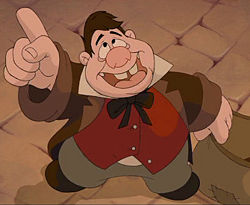
As long as you have a well-rounded primary villain to pit against your hero/heroine, secondary villains, while not great characters themselves, can definitely be an asset to your story! Try one out sometime! :D
Random Movie Quotes
Don't know what this is? Click here.

The film is called The Neverending Story. The line (very tragic) was said by Rock Biter. Both of these were guessed first by The Housework Can Wait. So two points there! Great job! No one guessed the name of the actor that played him. His name was Alan Oppenheimer and he also did voices for Falcor, G'mork, and the Narrator. (Just a bit of totally useless trivia for you! :D) Thanks to everyone who participated! Great job!
Now, onto today's RMQ!
"There are no happy endings, because nothing ends."
Again, three points possible. One for the name of the film, one for the name of character who says the line, and one for the name of the actor. Good luck! :D
Wednesday, August 15, 2012
Best Villains of All Time?
"You look at the greatest villains in human history, the fascists, the autocrats, they all wanted people to kneel before them because they don't love themselves enough."
Tom Hiddleston
Let's talk villains!!! I'll do a series of posts on different types and classes of villains. Today, we're talking about Primary Evil Villains.
But aren't all villains evil, you ask? Well, yes. But there are different types of villains. Some are evil, some are kind of goofy/idiotic. And sometimes the rules for secondary villains aren't the same as for main ones. I'll address all this eventually, but for today I'm focusing on Primary, Evil Villains.
To define: These villains are the main antithesis to the hero/heroine. They are evil, ugly, intimidating, and always get booed by the audience.
What makes a great villain of this sort? Who are your favorites? How can we be certain our villains are popping off the page?
All right, one question at a time!
What makes a great villain? This is a loaded question, but the short of it is: the same things that make great heroes! That's right. Just as a perfect (i.e. flat), awesome, chivalrous, in-all-ways good hero will come off as cheesy, unrealistic, and forgettable, so all-bad villains will do the same. Why was Darth Vader so memorable? Because he "had good" in him, which Luke (his son, no less!) had to find, tease out, and convert. If you can make your villains every bit as rounded as your heroes, they're much more memorable.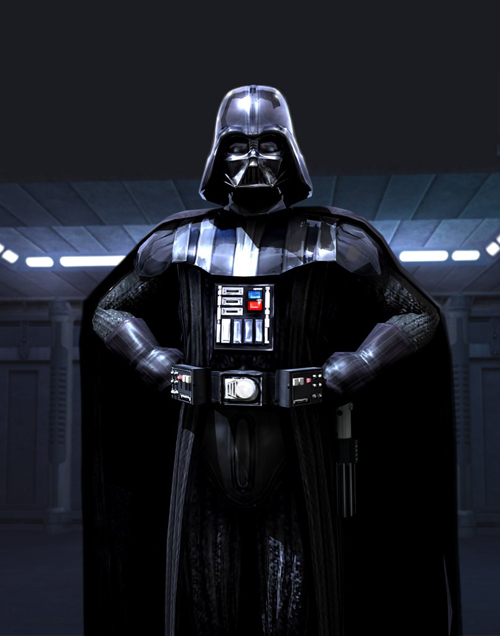 Let's talk about looks. Of course not all evil people look evil. (Pedophiles try to make themselves look pleasing in order to lure their prey, unfortunately.) Yet, even so, evil things in my experience just exude wrongness. It's hard to bring such an abstract feeling across in a story, so one great way to do it is through looks. Darth Vader's other major villain-advantage is his strange look, and (let's face it!) sound! Two breaths (hoe-puh!) and we know EXACTLY who we're supposed to be channeling. I'm sure there's something to be said about beautiful villains, and there are many examples of how well this can be done, but I'm more a fan of the intimidating villain. Looking scary is probably the best way to intimidate. Hence, my point.
 In Twilight, there's a child vampire named Jane. She is supposed to look very innocent, yet she can inflict massive amounts of pain and has no conscience about it. In the book, I thought she was a great villain, but I thought her big screen version lost something. Don't get me wrong: I'm a big Dakota Fanning fan, (?) but I just didn't feel the evil coming from her Jane performance. When I complained about it, my sister pointed out to me that in the book, that was why Jane was so creepy: because she seemed very innocent, but wasn't. I don't know, though. I still think there should have been something, anything, even something subtle that would make us afraid of her. For me, there wasn't. It came off as fake and pulled me right out of the story.
Maxwell Drake makes a good point about this. He says you can tell an awesome villain by how many kids go as them for Halloween. How many Darth Vader costumes get sold every year? It probably numbers in the hundreds of thousands. Lots of Darth Mals too. This year I'm sure we'll see plenty of Lokeys, Bains, Jokers, and various Hunger Games characters. Of course there's always Voldemort and Bellatrix Lestrange.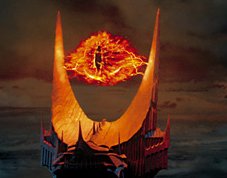 What about what Drake calls, "Tolkien's stupid big red eye"? (His words, not mine.) His point is that not many kids dress up as the "stupid big red eye of Sauron." Nor do we see many of Robert Jordan's Dark One. Why? Because they aren't tangible. We can't picture them. Kids have no frame of reference for how to pretend to BE them.
Make your villains tangible. How? Give them a memorable look. Give them range and depth. How? By giving them history and a back story.
In my opinion, there was nothing at all redeeming about Voldemort. He didn't have "some good" in him anywhere. Not anymore. So why was he an awesome villain? Well, his look was definitely memorable for one. He also had a complex back story. How does this make our villain's relatable? Because it makes them human. Maybe they're nothing but big stupid red eyes now, but once they were human. Once they made the same mistakes we do. And their choices led to their fate. J.K.Rowling's decision to link Harry and Voldemort was ingenious because it made us all very aware that Harry could possibly BECOME Voldemort (Heart of Darkness-style) and in our minds that posed a great threat to our beloved boy wizard. Hence, we became very involved in the story and chanted just as hard against the villain (Rick 'em rack 'em rock 'em rake! Stick that sword into that snake!) as we did for Harry (Yea, Harry!)
One more thing before I end: anyone know what a FOIL is? No, it's not shiny aluminum food-preserver! Only the geekiest of English majors know that a foil is when the attributes of one character bring out the opposite attributes of another. So a villain's evilness can serve to emphasize a heroes goodness. If your villain and hero are both well-rounded and your conflict puts them sufficiently at odds, this happens naturally. In other words, if your villain is awesome, your hero and story as a whole will be awesome too, by default! (Score!) Go through all of your favorite stories and see if this isn't true!
Some of the most memorable villains I've seen come across (other than those listed above):
Silas, of The Davinci Code (Self-flagellating, homicidal albino monk? Yeah, definite creep factor!)
Bane, of The Dark Knight Rises (Darth Vader face apparatus? Check. Interesting back story? Check.)
Jamie & Cercei Lannister, of A Song of Fire and Ice series (beautiful, but twisted and deceitful. Human like Greek gods are human, and similarly, don't piss them off!)
Jagang, of The Sword of Truth series
This is just a few that came readily to mind. Who do you think are the best villains of all time?
But aren't all villains evil, you ask? Well, yes. But there are different types of villains. Some are evil, some are kind of goofy/idiotic. And sometimes the rules for secondary villains aren't the same as for main ones. I'll address all this eventually, but for today I'm focusing on Primary, Evil Villains.
To define: These villains are the main antithesis to the hero/heroine. They are evil, ugly, intimidating, and always get booed by the audience.
What makes a great villain of this sort? Who are your favorites? How can we be certain our villains are popping off the page?
All right, one question at a time!
What makes a great villain? This is a loaded question, but the short of it is: the same things that make great heroes! That's right. Just as a perfect (i.e. flat), awesome, chivalrous, in-all-ways good hero will come off as cheesy, unrealistic, and forgettable, so all-bad villains will do the same. Why was Darth Vader so memorable? Because he "had good" in him, which Luke (his son, no less!) had to find, tease out, and convert. If you can make your villains every bit as rounded as your heroes, they're much more memorable.
Let's talk about looks. Of course not all evil people look evil. (Pedophiles try to make themselves look pleasing in order to lure their prey, unfortunately.) Yet, even so, evil things in my experience just exude wrongness. It's hard to bring such an abstract feeling across in a story, so one great way to do it is through looks. Darth Vader's other major villain-advantage is his strange look, and (let's face it!) sound! Two breaths (hoe-puh!) and we know EXACTLY who we're supposed to be channeling. I'm sure there's something to be said about beautiful villains, and there are many examples of how well this can be done, but I'm more a fan of the intimidating villain. Looking scary is probably the best way to intimidate. Hence, my point.Maxwell Drake makes a good point about this. He says you can tell an awesome villain by how many kids go as them for Halloween. How many Darth Vader costumes get sold every year? It probably numbers in the hundreds of thousands. Lots of Darth Mals too. This year I'm sure we'll see plenty of Lokeys, Bains, Jokers, and various Hunger Games characters. Of course there's always Voldemort and Bellatrix Lestrange.
What about what Drake calls, "Tolkien's stupid big red eye"? (His words, not mine.) His point is that not many kids dress up as the "stupid big red eye of Sauron." Nor do we see many of Robert Jordan's Dark One. Why? Because they aren't tangible. We can't picture them. Kids have no frame of reference for how to pretend to BE them.Make your villains tangible. How? Give them a memorable look. Give them range and depth. How? By giving them history and a back story.
In my opinion, there was nothing at all redeeming about Voldemort. He didn't have "some good" in him anywhere. Not anymore. So why was he an awesome villain? Well, his look was definitely memorable for one. He also had a complex back story. How does this make our villain's relatable? Because it makes them human. Maybe they're nothing but big stupid red eyes now, but once they were human. Once they made the same mistakes we do. And their choices led to their fate. J.K.Rowling's decision to link Harry and Voldemort was ingenious because it made us all very aware that Harry could possibly BECOME Voldemort (Heart of Darkness-style) and in our minds that posed a great threat to our beloved boy wizard. Hence, we became very involved in the story and chanted just as hard against the villain (Rick 'em rack 'em rock 'em rake! Stick that sword into that snake!) as we did for Harry (Yea, Harry!)
One more thing before I end: anyone know what a FOIL is? No, it's not shiny aluminum food-preserver! Only the geekiest of English majors know that a foil is when the attributes of one character bring out the opposite attributes of another. So a villain's evilness can serve to emphasize a heroes goodness. If your villain and hero are both well-rounded and your conflict puts them sufficiently at odds, this happens naturally. In other words, if your villain is awesome, your hero and story as a whole will be awesome too, by default! (Score!) Go through all of your favorite stories and see if this isn't true!
Some of the most memorable villains I've seen come across (other than those listed above):
Silas, of The Davinci Code (Self-flagellating, homicidal albino monk? Yeah, definite creep factor!)
Bane, of The Dark Knight Rises (Darth Vader face apparatus? Check. Interesting back story? Check.)
Jamie & Cercei Lannister, of A Song of Fire and Ice series (beautiful, but twisted and deceitful. Human like Greek gods are human, and similarly, don't piss them off!)
Jagang, of The Sword of Truth series
This is just a few that came readily to mind. Who do you think are the best villains of all time?
Subscribe to:
Posts
(
Atom
)