
Author Liesel K. Hill's Musings on Fantasia...
Showing posts with label How-to. Show all posts
Showing posts with label How-to. Show all posts
Monday, January 18, 2016
5 Tips for Writing Interrogation Scenes that Pop
 |
| Picture Source |
While working on my WIP, I had an interrogation scene to write, and I had no idea where to begin. I actually skipped over it when writing the first draft, because I knew I needed to do some thinking about it. But when I went back after that, I still didn't know what to write. Now, I DID do an interrogation scene in The Botanist, but it wasn't a conventional scene. It was more of a talking-to-person-of-interest-with-psychological-problems sort of scene, rather than a get-a-confession-out-of-a-perp scene. And it was rather tragic, which most interrogation scenes aren't. So I was still stuck when trying to write my more conventional interrogation scene.
Then I discovered a blog post with tips on writing interrogation scenes. Just what I needed! So I decided to share them. These original tips came from author Chrys Fey and the original post can be found HERE.
For your interrogation scene, you basically need to decide who is going to play what role:

Monday, December 8, 2014
3 Tips to Help You Settle into a Writing Schedule
 |
| Source |
Recently I switched to a job that will give me both more time and more ability/inclination to write. Still, I had to get used to the new job, work around the hours, and settle into a routine. It can be challenging. So, here are a few tips for those of you who constantly struggle with finding time to write.
1
 |
| Source |
2. Commit to them. Set them aside and don't plan anything in those slots. You'll be tempted to do other things during this time: shop, do chores, catch a few winks. And I get it. The holiday season can be downright exhausting. Keep the planned writing times you've made, though. Success comes to those who work harder than everyone else.
3
| Source |
Hope these steps help you. They definitely have me.
What helps keep you on track during the holidays? Have any tips to add?
Monday, November 17, 2014
Tips for Writing in Multiple Genres
 |
| Source |
The famous line from Norman Maclean's classic novel, A River Runs Through It, says "Eventually all things merge into one, and a river runs through it."
Maclean's point was that often in society we kill each other over details when really we aren't all that different from one another.
I'm gonna take that argument and apply it to genres.
For past generations of authors, they usually had to pick a genre and make their career in that genre. Because it took so much--face to face sales, book tours, radio/TV spots--to sell books, they had to stay in the same niche in order to be successful.
And of course every author is biased toward their own genre. Understandable, perhaps, but the fact is that every good story has similar components. All stories have to have great plots that follow the same basic structure, great characters, great writing, etc. They aren't actually very different from one another. Genre is just a detail.
There are only so many stories, so many conflicts. (Man vs. man, man vs. himself, man vs. nature, man vs. society, etc.) which means that, as authors, our originality=0. It's our creativity that makes us great story tellers.
All stories basically merge into one.
All stories basically merge into one.
Let's look at dystopian as an example. All dystopias (Hunger Games, Divergent, The Road, The Walking Dead) have the same basic structure. Actually, I've made the argument multiple times that all stories are inherently dystopian. If there wasn't something undesirable about the world of your story, you wouldn't have a story to tell.
But all dystopians have the same elements--both as one another and as other stories. It's the details that set them apart. Details set different novels in same genres apart. Genres set apart all stories.
Why People Say You Shouldn't Write in Multiple Genres:
Monday, November 10, 2014
5 Tips for Writing Middle-Grade Characters

In my writer's group, he was one of the favorites. And for good reason: he's really fun and his story is adventurous. But for me, he's also the most intimidating to write because I don't generally write MG. I don't know how. And I struggle to make him sound like a kid that is smart, but not pretentious.
Even though even this story is for adults, I thought if I learned how to write MG and incorporated that into Rolly's POV, it would make my character feel more like a real kid. So, a lesson in writing MG was in order. Here are some tips I picked up:
5 Elements that kids (as readers) crave in their books:
 |
| Source |
- malapropisms (i.e. misusing words)
- non sequiturs (i.e. illogical conclusions)
- things that are out of place
- Rule of 3 works well (i.e. underwear, socks, and a penguin)
- words with K or G sound (this is a research/psychology thing; really not gonna try and explain it)
- things that are taboo
- use humor in description and how characters see themselves
- do NOT use sarcasm; children of this age don't usually get sarcasm, especially in writing
 |
| Source |
2) Being Scared -- Use:
- creepy setting
- cliffhangers
- suspense
- running from a foe
- make reader worry about what might happen
- STAY AWAY from gore for this age group
3) Mystery -- How to Create it:
- build curiosity (i.e. Is this a friend or foe?)
- hint at things (i.e. monster, treasure, etc.)
- if there's a threat to the MC's happiness = stronger mystery
- solve the mystery after not too long; MG = short attention span
- make sure and leave breadcrumbs along the way
- DO NOT use confusion
- the POV character CANNOT know secrets; they have to be the one finding them out
4) Action/Adventure
- unlike films, books must use thoughts and emotions for actions scenes; these must be applicable to the MG age group
- have clever dilemmas/creative situations
- show character being clever
- make reader care about characters
- don't go too long without action; can be small action, but get your characters moving
- try to do description before action scene, rather than during
 |
| Source |
5) Sense of Wonder
- Fantasy/speculative fiction naturally induces this
- science experiments
- setting
- characters
- animals
- look at everyday stuff differently
- with every bit of wonder, there needs to be a bit of familiar ground
- characters should fail spectacularly, but not stupidly, or you lose the respect of your reader
- make conflict personal to the characters (i.e. parents as zombies, things kids would care about)
- characters must always have a chance of winning
 |
| Source |
More Random MG Tips:
- Sacrifice everything for clarity; these readers are young. YOU. MUST. BE. CLEAR!
- Do your dialogue attributions ASAP. Again, children will be confused more easily than adults. Do the attribution before the dialogue, rather than at the end, if at all possible.
- In late, out early. Keep your scenes short.
- Awesome names are a huge plus!
Basically all of these things can be applied to any genre and age group, but they're especially important in MG, where things need to be clear to the point of obviousness and simple to the point of being trite. Of course, when done well, MG is neither obvious nor trite. It's magical and fabulous!
So, hopefully these tips are helpful to you. Even if you don't write MG, if like me you have a young character, incorporating these tips into your writing of them (especially if it's their POV) will help them feel more authentic. Give it a shot. I know I'm going to.
So, any MG writing tips I missed? Which ones stand out to you?
Monday, June 23, 2014
The Best Way to Get Your Writing/Editing/Important Tasks Done
 |
| Source |
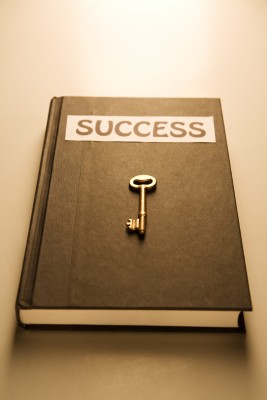
One of they best books you could ever read to ensure your own success is Success Principles by Jack Canfield. I'm making my way slowly through it, and I found a particular suggestion that I took to heart. I've done posts before about how to be productive, and this goes hand in hand with that.
Mr. Canfield suggests keeping a "success journal." Basically, it's just something in which you write down the successes you had during your day.
In our society, we focus far too much on our failures. We think, "sure, I did x, y, and z, but I didn't get this other thing done." And we totally beat ourselves up for that one thing, without giving ourselves enough credit for the things we did get done.
Our successes can be anything and everything we did right during the day. Did we wake up on time? Squeeze in a workout? Eat a healthy lunch? Did we get any reading, writing, or editing done? Did we spend quality time with the family, or do some cleaning we've been meaning to get around to for a while? All of these are successes.
So, find a journal or notebook, and right before you go to bed, write down everything you succeeded out during the day. You can be grateful for what you got done, and dwell on the positivity of your day, which will put you in a success mindset for tomorrow. You can also look at what you did and plan what you want to get done tomorrow. I've started doing this, and it's not only helped keep me on track for my tasks, but it puts me in a "go and do" mindset. I want to have things to write in my success journal, which motivates me to stay on task and get things done.
It's such a small, simple thing--some people may even think it foolish--but give it a try. You might be shocked at what it does for your productivity.
Happy Monday, Everyone! Have a successful, productive week!
Wednesday, February 12, 2014
10 Things You MUST Consider When Editing a Scene
After having written five full length books (only three of which are currently available for sale) and working on the next two simultaneously, I think I have my own writing process pretty well worked out.
Generally when I write my first draft, I focus on action and pushing the narrative forward. I pay very little attention to things like character quirks, setting description, foreshadowing, etc. This is the draft that goes to my writer's group so they can tell me where my story is weak, where there are discontinuities, and where it needs more work.
I often get comments about needing more description, fleshing out characters more, etc. And that's okay. The characters are already fleshed out in my head, and while I know that doesn't help the reader, details like that are what my second draft is for.
As I'm currently in a predominantly editing mode right now, for both book 1 of Dragon Magic and book 2 of Street Games, I thought I'd do a post about all the details I edit for when I do my second draft.
Even if your process is different than mine, these are things that ought to be considered for every manuscript. Pay attention to these details and you'll end up with a fabulously-written novel.
Generally when I write my first draft, I focus on action and pushing the narrative forward. I pay very little attention to things like character quirks, setting description, foreshadowing, etc. This is the draft that goes to my writer's group so they can tell me where my story is weak, where there are discontinuities, and where it needs more work.
 |
| Source |
As I'm currently in a predominantly editing mode right now, for both book 1 of Dragon Magic and book 2 of Street Games, I thought I'd do a post about all the details I edit for when I do my second draft.
Even if your process is different than mine, these are things that ought to be considered for every manuscript. Pay attention to these details and you'll end up with a fabulously-written novel.
Monday, February 3, 2014
Tips for an Awesome KDP Promo!
This past month (January) I ran my first real KDP promotions, and they went great!
 The first one I ran was on my book Quantum Entanglement, Book 2 of Interchron. I knew it would be kind of a weird promo, because it's book 2 of the series. Usually you do a book 1 promo. Now, I wouldn't necessarily recommend doing book 2, but my hands were tied here. Book 1 was self-published, which means I can't control the price. Book 2, on the other hand, is self-published. So, I just decided to do a promo on book 2 in the hopes that at least some people would go back and download book 1 and make me some money. (I won't actually know whether or not they did for another week or so, when I get my royalty report from my publisher, so I'll let you know. :D)
Anyway, long story short, I did the promo on Quantum Entanglement, and just didn't expect much. To my shock, 1,328 copies were downloaded over 2 free days. Yippee!
Now, before anyone lectures me, I know that not everyone delves into their free books right away, if at all, and that if anyone does download book 1, the percentage will likely be small.
Yeah, I don't care.
Anyway, long story short, I did the promo on Quantum Entanglement, and just didn't expect much. To my shock, 1,328 copies were downloaded over 2 free days. Yippee!
Now, before anyone lectures me, I know that not everyone delves into their free books right away, if at all, and that if anyone does download book 1, the percentage will likely be small.
Yeah, I don't care.
Wednesday, January 22, 2014
The Three Best Things You Can Do for Your Productivity This Year!!!
 |
| Source |
Problem is, I'll be doing more working-at-the-day-job kind of stuff this year, which means I'll have less time, not more, than I used to, and yet I have more things to get done. (Isn't that always the case?) So, how can I keep up my writing momentum and get done everything I want to without being a 24/7 hermit?
Thursday, January 9, 2014
7 Tips for an Awesome Email Newsletter
 |
| Source |
I realized that I needed to do some research to make sure I was putting out a quality newsletter and that I would in fact be growing my list, rather than the other way around. So, I googled something like "great author newsletters" and started scouring the internet for information.
Here's what I came up with:
- Open layout. Use images, colors, bold headlines, etc. with plenty of white space. No one wants to read a dense block of text. Have clearly designed sections (i.e. Announcements, on the blog, etc.)
- Put a clearly defined call to action, both at the beginning (in subject and/or header) and at the end, just before the close.
- Include social media buttons to encourage sharing and interaction
- Quality Content. Whether it's tips and tricks, announcements, recipes, or anything else you may be sending to your email followers, make sure they're giving them quality content. And what's the secret to that? Remember that this is about THEM, not YOU. Give them something they can use and enjoy. If it's all the party of you in every newsletter, they'll get sick of reading real fast.
- Tone. Make sure the language you use is warm and conversational. Or perhaps punchy and sarcastic. How you write is really all about your style, but 1) make sure it jives with your overall style on all your networks and blog, and 2) if you're critical and negative all the time, your email list will shrink in record time.
- Some research shows that newsletters sent between 6-10 a.m. or 7-10 p.m. get more opens and more clicks. Some people even suggest you should differentiate using time zones. That's a little extreme for my modest little newsletter, but it's not necessarily a bad idea. Just something to keep in mind.
- I'm going to throw in my own tip here. This isn't something I came across, at least not directly, but I'd try to put at least a little bit of humor or sentimentality in your newsletter. If people smile for any reason, they'll associate good things with your newsletter and want to open it when it lands in their inbox.
Of course, you must always use common sense when emailing people. Don't spam. Don't blitz them with unending emails screaming, PLEASE BUY MY BOOK in all caps. Just don't do that. (Not only will your list shrink, but you'll probably get reported to people who take spammers very seriously and can make your life very miserable.)
Below, I've pasted screenshots of my first newsletter. It may change over time. I'll experiment and see what works, what gets the most clicks, etc., but here's my first attempt. I'd love to hear what you think of it. Suggestions? Tips? Any problems you see?
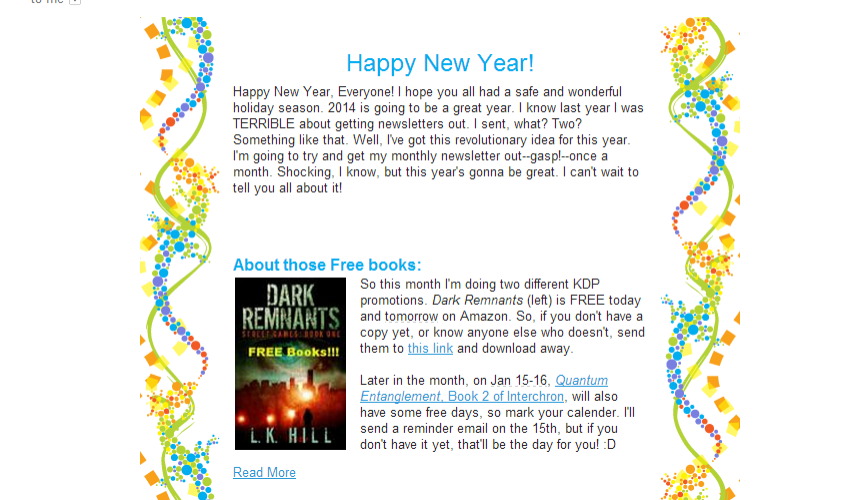
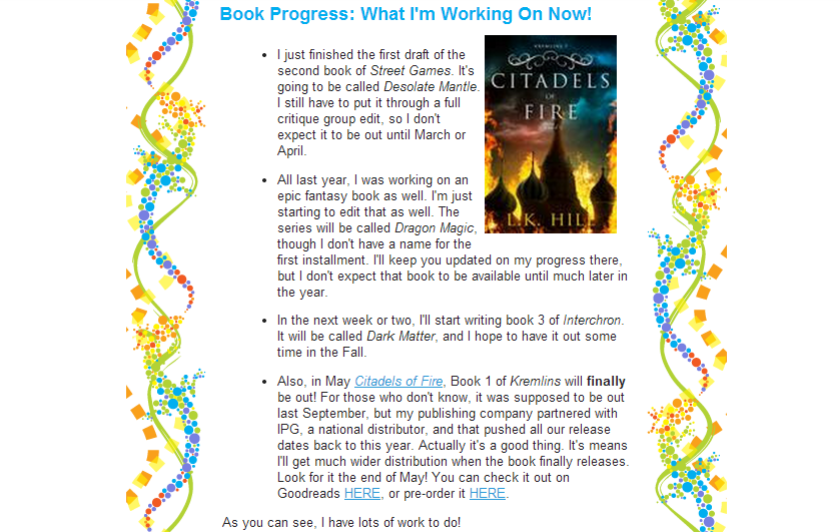
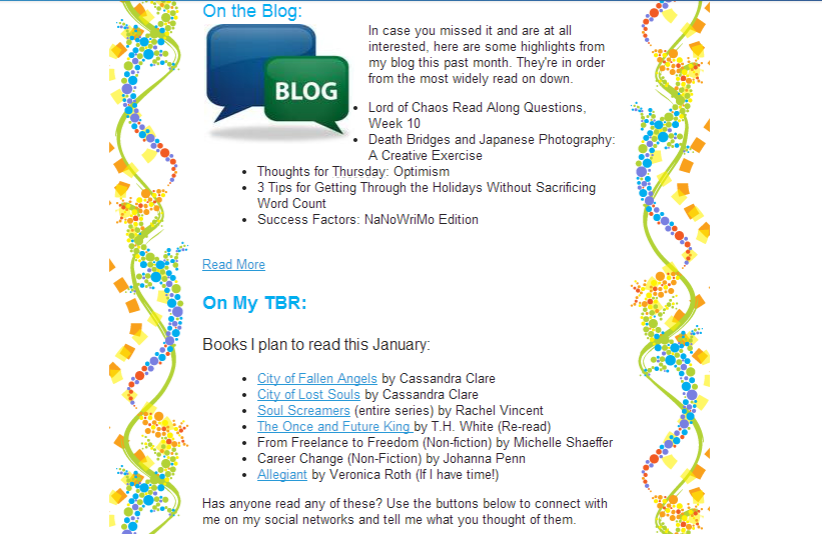
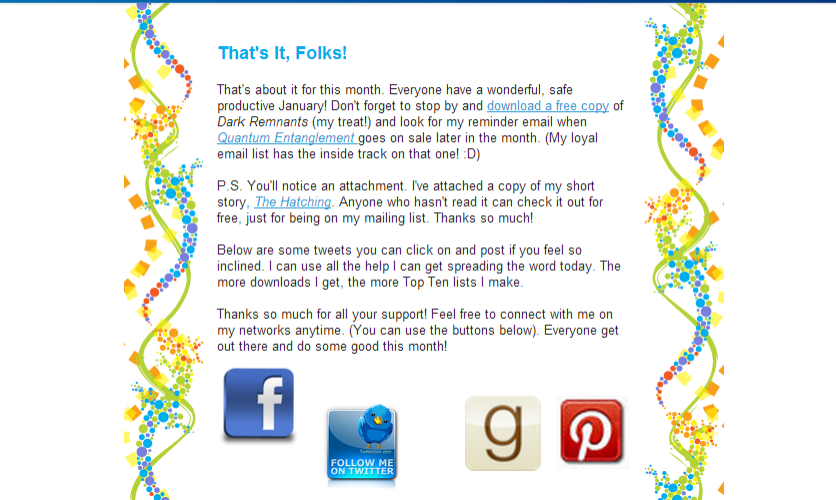
Any suggestions? Do you have any secret weapons you use in your newsletter?
Monday, December 9, 2013
3 Tips to Get Through the Holidays Without Sacrificing Word Count

.JPG)
Here in Utah, the first big snow of the season has hit. We've had previous snow, but it's been small storms that have melted away within a few days. This is a three-day-long dump that's leaving the sidewalks slippery, the visibility terrible, and the roads downright scary.
Winter anyplace that has extreme weather can put a strain on your writing time. Longer commutes, holiday events, and the inevitable rise in day-to-day problems can put a major cramp in your author style. So, here are some tips for keeping up on your writing work and word count.
Subscribe to:
Posts
(
Atom
)