
Author Liesel K. Hill's Musings on Fantasia...
Wednesday, September 5, 2012
Best Villains of All Time--Part 3
"Oh villain, villain, smiling, damned villain!
My tables--meet it is that I set it down
That one may smile, and smile and be a villain--"
--Shakespeare, HamletSorry it's taken me so long to get to the final installment of this series! I've had a busy couple of weeks and I haven't been able to devote as much time to my blogs as usual. Back on track now, though.
My first post was about primary villains. The second was about secondary villains. For the final installment of my villains series, I want to talk about the comedic and/or comedy villain! This is something that, in my opinion, can be a fascinating character study, but is not done very often, or at least is not done very well.
Let me explain what I mean by these terms. The place I found the best definition is called Villains Wiki. It states the following:
Comedic Villains are evil characters who are shown to have a sense of humor, usually a rather dark one, and express it while they do their evil doings. This is not to be confused with the Comedy Villain, as although there is a massive overlap, the difference is that while a "Comedy Villain" is any that is intended to be funny to the viewer, even if they take themselves completely seriously within the story itself (where they would be funny due to their unintentional ineptitude and/or the general absurdity of a ridiculous story), the "Comedic Villain" is defined by the character him/herself having a deliberate sense of humor and making jokes within the story itself. A particularly dark variety of this, where the villain in question is not a "Comedy Villain", is a "Comedic" villain who performs truly heinous acts such as murder and torture, but jokes about them as if they were much less serious, demonstrating an insensitivity to the severity of their own actions and/or general insanity.
So what are some examples?
Understand that, almost by definition, such villains will never be dynamic. He or she will start out evil and end up evil, too. The audience's fascination comes from his humor and the fact that he's totally evil, but makes them laugh. They don't root for him. They totally hope the hero/ine gets to kill him in the end, but they like watching the villain nonetheless. This kind of villain is perfect for the description, 'you love to hate him.'
The Bad:
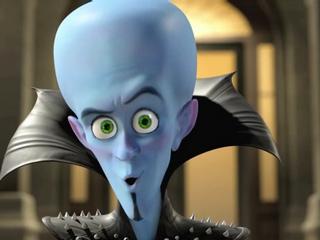 |
| Source: rottentomatoes.com |
Okay, I know there are a lot of people who like this movie, so try not to be offended that I put it on the bad list. I actually haven't even seen all of it. The reason I put it on my bad list is that I know this film didn't do very well critically or at the box office. When I watched some of it (mostly just the ending) I understood why. This film was sold (by it's trailer) as being a good vs. bad superhero cartoon. Yet, by the end, Megamind (apparently the bad guy) converts over to being the good guy, saves the world and gets the girl. I'm not even sure what happens to the superhero-good-guy. I think at some point Megamind kills him. Now, this isn't bad in itself, but it's not what people were expecting, based on the trailer. I think audiences were mostly just disappointed. Why? By choosing to end the movie this way, they completely undermined the villain. Don't do this with your villains! At least, not the comedic ones. As we've already discussed, they need to remain evil for the most part!
I know, I know. Some of you are going to point your finger at me and scream Star Wars. And you have a point. But it's still a different situation. Granted, Vader turned good at the end, but it didn't matter. 1) By then there was a well-established eviler villain (the emperor), and 2)his turning in no way diminished his villain status throughout the rest of the franchise. He was so firmly ingrained in our minds as a villain, that it didn't matter. Now, understand that it took three movies, many years and possibly the largest movie franchise in history to make him that way. So, if this is a short story or stand alone movie or novel that isn't well-established in pop culture and you try to do this, it's going to fall flat with audiences. Sorry folks. Just the way it is. Furthermore, Darth Vader wasn't a comedy/comedic villain, so he gets a free pass anyway.
 |
| Source: chasingthefrog.com |
Bad Batman Flicks
 |
| Source: batman.wikia.com |
If your villain spends the entire story running around laughing hysterically at jokes only he understands and thinks are funny, you're going to lose your audience pretty quickly. Granted, they'll be creeped out, but after about five minutes they're going to want more and if they don't get it, your villain will be labelled as stupid. This has happened way too often in the past with comic book villains!
Robin Hood Villains
The villains in Robin Hood have been done so many times and in so many ways that I could go on and on about them. (Don't worry, I won't.) One that was handled poorly is the tiara-wearing King John of the 1973 Disney Cartoon. This villain was whiny, immature, babyish, and just plain annoying. Granted that may partially be because he was the villain of a children's cartoon, but still. I can't help but wonder if the decision to make him that way was politically motivated--1970s and all.
The Good:
All right! Enough with the bad! Let's talk about when this type of villain has been done well!
First--you knew I was going here!--Heath Ledger's the Joker. Yup, that's right! This villain was good enough to make it into two out of three of these posts. Ledger gave us the ultimate comedic villain. He was all kinds of evil and we couldn't wait for Batman to beat him. His laugh was just maniacal enough to go straight to our spines, but he made just enough sense to freak us out. He did aforementioned maniacal laugh while performing evil deeds, but took himself completely seriously. He was just as evil and crazy at the end of the film as he was at the beginning.
I read somewhere that in the famous scene in the jail where the mayor names Detective Gordon as Commissioner, Gary Oldman was freaked out. In the movie, we see the Joker applauding in an over-the-top, ridiculous way while the new Commissioner's co-workers cheer him on. Gary Oldman said that the Joker applauding was not in the script. Ledger just did that because he was so in character. Now, most of us in the audience laughed at that, and Oldman has done a good few villainy roles and been pretty dang good at them, but when he turned around and saw Ledger doing that he went, "Whoa. That's kind of creepy." That says a lot.
 |
| Source: aveleyman.com |
To this day, this is one of my all-time favorite movies. Alan Rickman's performance may not be the ONLY reason for that (the medieval setting and awesome romance couldn't possibly have anything to do with it *averts eyes*) but he's definitely a big part of it.
I hope someday to be able to create a memorable comedic or comedy villain.
What do you think? Who are your favorite comedy/comedic villains?

Tuesday, September 4, 2012
Top Ten Tuesday--Fall Reading List

Each week we will post a new Top Ten list that one of our bloggers here at The Broke and the Bookish will answer. Everyone is welcome to join. All we ask is that you link back to The Broke and the Bookish on your own Top Ten Tuesday post AND add your name to the Linky widget so that everyone can check out other bloggers lists! If you don't have a blog, just post your answers as a comment. Have fun with it! It's a fun way to get to know your fellow bloggers.
Top Ten Books On Your Fall TBR List
For my Fall TBR list, I'm going to focus on several books that I think would be fun Halloween reads. In other words, they focus on vampires, zombies, ghosts, etc. Here they are!
10. Beautiful Lies

9. Crossroads


7. The Unquiet


What are your Top Ten Fall Reads?
Random Movie Quotes (RMQ)
Don't know what this is? Click here.

So yesterday's RMQ was this: "Where HAVE you been! Beds empty...no note...car gone! You could have DIED. You could have been seen!"
This was of course said in Harry Potter and the Chamber of Secrets by Mrs. Weasley, played by Julie Walters. :D
Congratulations to Alex Cavanaugh for guessing it! He is officially my high scorer and the one to beat! Great job, Alex!
Congratulations to Alex Cavanaugh for guessing it! He is officially my high scorer and the one to beat! Great job, Alex!
Now for today's RMQ:
"Whether by your will or not, there is no ship now that can bear me hence."
As usual, one point for the film, one point for the actress, one point for the character. Any guesses?
Monday, September 3, 2012
Three Things to Consider This Labor Day! Plus RMQ!
Good Monday, everyone! Happy Labor Day! I'm sure everyone's bright-eyed and bushy-tailed today! :D
The first two things are just announcements. The third has to do with deeper thoughts! Consider this:
1) My cover.
Giselle of Xpresso Reads featured my book's cover on her FB page on Sunday. If you could take a minute to click the link and "like" her post, I'd really appreciate it! :D Going along with that, I'm currently setting up other cover reveals so you'll see my book's cover around a bit more. Keep an eye out for it!
2) Dragons
My second announcement is probably more exciting for me than for you, but I finally started writing my high fantasy project. (Yea!) On Sunday morning I wrote the first chapter. It was exciting to finally begin writing it, especially as it was the first time I've written something new and original in about a month. I've been busy editing and moving to a new apartment, so my treasured writing time has kind of disappeared. It's so great to get back on track. And remember, this new story features dragons! :D
3) Memories
Okay, so let's briefly talk about memories. How important are memories in our lives? I think we can all agree: VERY!
Our memories define who we are...to ourselves. Other people define us by what their five senses tell them and by what they know of us, but without memories, how are we to know ourselves?
But what if you lost a year of your memories? What if you found out that during that year you made friends, went on important missions, and fell in love...and now you remembered none of it? What if you could never reclaim those memories? What if the reason for the memory loss...was your fault?
 Persistence of Vision, coming winter, 2012.
Happy Labor Day everyone! :D
So the RMQ from Friday was:
"Did you see that? She stole that tie! It's a perfect crime. Girls don't wear ties!"
"Yes, if she murdered the tie it would be a perfect crime."
No one guessed this one. It's from an old movie starring Dudley Moore called Arthur. They recently did a (somewhat hokey, but still entertaining) remake with Russell Brand. The first line was said by Dudley Moore, as Arthur, a rich, lovable playboy millionaire. The second was said by the wonderful John Gilgud, as Hobson, his butler. :D
My parents quoted this line ALL THE TIME when I was a kid. I could quote the line long before I ever saw the movie!
Now for today's RMQ: (slightly easier)
Who said it? One point for film (be specific!), one for character, one for actor...Go!
The first two things are just announcements. The third has to do with deeper thoughts! Consider this:
1) My cover.
Giselle of Xpresso Reads featured my book's cover on her FB page on Sunday. If you could take a minute to click the link and "like" her post, I'd really appreciate it! :D Going along with that, I'm currently setting up other cover reveals so you'll see my book's cover around a bit more. Keep an eye out for it!
 |
| Source: Fanpop.com |
My second announcement is probably more exciting for me than for you, but I finally started writing my high fantasy project. (Yea!) On Sunday morning I wrote the first chapter. It was exciting to finally begin writing it, especially as it was the first time I've written something new and original in about a month. I've been busy editing and moving to a new apartment, so my treasured writing time has kind of disappeared. It's so great to get back on track. And remember, this new story features dragons! :D
3) Memories
Okay, so let's briefly talk about memories. How important are memories in our lives? I think we can all agree: VERY!
Our memories define who we are...to ourselves. Other people define us by what their five senses tell them and by what they know of us, but without memories, how are we to know ourselves?
"Memories are intensely personal things...they're like rivers of identity that seep into the pores of your soul."
--The Remembrancer, Persistence of Vision
But what if you lost a year of your memories? What if you found out that during that year you made friends, went on important missions, and fell in love...and now you remembered none of it? What if you could never reclaim those memories? What if the reason for the memory loss...was your fault?

Happy Labor Day everyone! :D
Random Movie Quotes (RMQ)
Don't know what this is? Click here.
So the RMQ from Friday was:
"Did you see that? She stole that tie! It's a perfect crime. Girls don't wear ties!"
"Yes, if she murdered the tie it would be a perfect crime."
No one guessed this one. It's from an old movie starring Dudley Moore called Arthur. They recently did a (somewhat hokey, but still entertaining) remake with Russell Brand. The first line was said by Dudley Moore, as Arthur, a rich, lovable playboy millionaire. The second was said by the wonderful John Gilgud, as Hobson, his butler. :D
My parents quoted this line ALL THE TIME when I was a kid. I could quote the line long before I ever saw the movie!
Now for today's RMQ: (slightly easier)
"Where HAVE you been? Bed's empty...no note...car gone. You could have died! You could have been seen!"
Who said it? One point for film (be specific!), one for character, one for actor...Go!
Thursday, August 30, 2012
Feature and Follow Friday--Best Covers

Gain new followers and make new friends with the Book Blogger Feature & Follow! If this is your first time here, welcome! You are about to make some new friends and gain new followers -- but you have to know -- the point of this hop is to follow other bloggers also. I follow you, you follow me.
The Feature & Follow is hosted by TWO hosts, Parajunkee of Parajunkee's View and Alison of Alison Can Read. Each host will have their own Feature Blog and this way it'll allow us to show off more new blogs!
How does this work? First you leave your name here on this post, (using the linky tools -- keep scrolling!) then you create a post on your own blog that links back to this post (easiest way is to just grab the code under the #FF picture and put it in your post) and then you visit as many blogs as you can and tell them "hi" in their comments (on the post that has the #FF image). You follow them, they follow you. Win. Win. Just make sure to follow back if someone follows you!
Hop over to Alison Can Read for the feature!

Q: Best cover? What is the best cover of a book that you've read and loved?
I'm going to have to do a Wheel of Time plug here. A month before I began my sophmore year of high school, I went into Media Play (now defunct) and saw a huge display that had this book on it: *slide eyes to right*
The title is A Path of Daggers.
For some reason, I went back to that same store two or three times in two weeks. Each time, I picked up the book and just thought it looked awesome. I love high fantasy. Anything with kings, queens, armies, knights, swords...you get the picture. The only problem was that this was Book 8! Finally, two weeks before starting school, I bought book one. The rest is history: my love affair with Robert Jordan's world of The Wheel of Time had begun. When the final book comes out in January--sadly--it will end. So that's my best cover story for fantasy.
For some reason, I went back to that same store two or three times in two weeks. Each time, I picked up the book and just thought it looked awesome. I love high fantasy. Anything with kings, queens, armies, knights, swords...you get the picture. The only problem was that this was Book 8! Finally, two weeks before starting school, I bought book one. The rest is history: my love affair with Robert Jordan's world of The Wheel of Time had begun. When the final book comes out in January--sadly--it will end. So that's my best cover story for fantasy.
Don't know what this is? Click here.
Again, I don't usually do these on Fridays, but I've been kind of remiss this week so I'm doing one today. Yesterday's RMQ was: "What's he do? Nibble your bum?"
Alex Cavanaugh guessed the film. It was Monty Python and the Holy Grail! Good job, Alex! No one guessed the actor or character, but that's okay. One point for Alex.
Now onto today's RMQ:
"Did you see that [name]? She stole that tie! It's the perfect crime--girls don't well ties!" "Yes, if she murdered the tie it would be a perfect crime."
So five points possible for this one: the character and actor for the first line, the character and actor for the second line, and the film.
Any guesses?
Thoughts for Thursday (3) and RMQ!

WELCOME TO THOUGHTS FOR THURSDAY!
Thoughts for Thursday is a new meme hosted by Musings on Fantasia and LKHill. In this meme, we share thoughts or quotes that we know or have recently come across. Each week there is a specific subject or theme. These can be quotes from books, quotes by famous people, (quotes by YOU, perhaps ;D). Anything from anywhere is game, though we do ask that you keep your quote to a few sentences at most. Don't quote, for example, entire passages of a book or essay. These can be funny quips, cool sayings, hair-raising antidotes, movie lines, any kind of quote you can think of!
Readers may respond by either commenting on the quote I put forward or contributing a quote of their own. I'll include a linky list, or you can just respond in the comments.
Just have fun, collect awesome sayings by awesome people, and try to be inspired!
This week's theme is "writing fantasy."
All the works of man have their origin in creative fantasy. What right have we then to depreciate imagination.
Literature for me isn't a workaday job, but something which involves desires, dreams and fantasy.
--Antonia Tabucci
What do you think about these quotes? Which one do you like better? How do you apply it to your own writing? Do you have any interesting quotes about writing fantasy?
Random Movie Quotes (RMQ)
Don't know what this is? Click here.
I don't usually do RMQ on Thursdays, but I haven't done ANY this week! (Sorry, it's been kind of crazy), so here it is! :D
 The last RMQ I did was last Wednesday. It's okay if no one remembers, because no one guessed it anyway. The quote was "There are no happy endings, because nothing ends." That was said by Schmendrick the Magician in the timeless cartoon, The Last Unicorn. Our geeky magician was voiced by Alan Arkin.
Now for today's RMQ. Ready?
"What's he do? Nibble your bum?"
Who said it? What film, what character, what actor? Three possible points! Any guesses?
Tuesday, August 28, 2012
Pushing the Limits Read-Along Week 5

1. By finally returning to her art, Echo is working through her issues and taking control of her life. While she’s not ever going to return to her previous “normal”, she uses her art as a way to work her way to a place where she’s more comfortable with herself. How do you deal with the issues and stresses of your life?
A: Writing is definitely cathartic to me. I always feel more emotionally stable when I've spent some time with my characters, hashing out their problems and dealing with their emotions. :D
2. Once Noah gives his brothers and their soon-to-be adoptive parents a happy ending, he decides to get his own by winning Echo back. Why does he think stealing her file is the best way to do it? Any other (better) suggestions for the poor boy?
A: Um...just go talk to her. I know he wanted some major good will gesture, but talking to her, explaining how the situation has changed and telling her that he wants/loves her would probably be more than enough.
3. Echo finally uncovers the terrible truth of what her mother did to her. Now that we know the truth, do you think Echo’s father did the right thing by covering up the incident and keeping it from her? How do you think he should have handled it?
A: I think Echo's father did what he thought was best. Even if he didn't reveal the entire, awful truth, perhaps he could have just told her some of it--that there was an incident and she got hurt and what his part in it was. Even without the gory details, perhaps she would have been able to deal with it better if she thought her father was being honest about it.
4. Mrs. Collins plays an integral role in helping Echo and Noah find a new normal and happiness in their lives. Tell us about someone in your life who helped you, someone who changed your life, was there for you, or offered help/comfort when you most needed it (or when you didn’t know you needed it).
A: I'm very close with my sisters and they are always there for me when I needed them. They are my closest friends and companions. There have been countless times when they've helped me through things.
5. Another major truth is revealed when Echo’s father finally opens up to his daughter and tells her about her mother and how his relationship with Ashley evolved. Knowing this, how do you feel about Ashley now? And what did you think when you learned the name of the baby?
A: I always thought Ashley was getting an "evil step mother" rap from Echo that she perhaps didn't entirely deserve but it's only to be expected from a child whose parents split up. After learning the truth, I like her a lot more than I did before and I think the baby's name is sweet and tasteful and a good way to bring the family closer together.
6. Echo and Noah ride off into the sunset together. *happy sigh* If you had the chance, who would you ride off with and where would you go?
A: Hmmm...since I'm still single I think I'd have to chose a hunk from one of my favorite fantasy novels. Not sure which one, thought. I'll have to give this some serious thought...:D
What did YOU think of the book?
Monday, August 27, 2012
Five Things You Probably Don't Know About Dystopian Literature

Not many people outside the writing/publishing industry have the word dystopia in their working vocabulary (understand that I include those who write films). Yet, the more I learn about dystopian stories and their psychological effect on our modern society, the more important I realize they are. I've thought about this a lot lately but then I read a column by Steven Kalas that really got me thinking about it.
Here are the conclusions I've drawn (so far) and that I think everyone should be aware of concerning dystopian stories of any kind:
1) The definition: a dystopia is a society characterized by human misery (i.e. squalor, oppression, disease, overcrowding, etc.) see source


3) Depending on how you mold the definition to fit whatever aspect you are addressing, any story, specifically any conflict, can be characterized as a dystopia. Now don't get me wrong: if we're talking about a man vs. himself kind of conflict that has nothing to do with society, and you try to categorize that as a dystopia, lots of people in the industry will shake their heads in your general direction. But, if a character's main conflict is within himself, then his "society" is what's inside his own head. If he's miserable in some way, then your story is dystopic. (Kafka would be an expert at this. As much as I hated The Metamorphasis, it IS actually relevant here.) I don't say this to confuse the genre issue, but only to point out that dystopias are simply conflicts on a societal level. They deal with how the individual reacts to a society-level problem, but more on this in a minute.


While I totally get that society is fast going into the toilet, I think it's important to point something out: we create these dystopian stories and the public eats them up, whether in book form or on the big screen, because we hunger for answers. Maybe we all do know that society won't be a utopia in the long run, so we crave these stories so that we can define ourselves in the face of what we believe society will become and keep ourselves from slipping into anarchy.
Granted, there were plenty of people prior to WWII that knew if the Nazis came to power, it would be a bad thing, and Hitler still made it to the top. But if some Joker-esque character showed up in NYC tomorrow, how many Americans would stand by idly and watch, much less follow him blindly? In my mind, not many. For us, it's a been-there-done-that situation, even if it was just in a film. My point, well it brings me to the fifth thing you should know about dystopias;
5) Dystopias help us work out our psychological issues. They become an outlet for how the individual reacts to society's problems. We watch them and we resolve within ourselves that we would be the one that was different; that we would stand up to the oppression (Christopher Nolan's Batman series) , find a way to feed our families (Hunger Games), keep the ones we love alive (every zombie move EVER!) or just all-out save the human race (I am Legend).
My point is that the entire reason we create dystopian art in any form is to keep it from happening in real life. It's the ultimate example of why we love to read stories about human beings in the midst of conflict: we want to educate ourselves, decide how we would react in that or a similar situation, and make ourselves better/stronger by it. If we can address our society's flaws and show why we must keep them at bay, we will be able to keep our society sane and ordered for that much longer. Hence, audiences drink up dystopian stories like people dying of thirst. After all, we can see aspects of society crumbling around us daily. So we read books and watch films about individuals banding together to reclaim their society and triumphing over all that is wrong with the world. Then we go back to our lives feeling a little stronger, a little more able to deal with our own problems.

Persistence of Vision
Winter 2012
Subscribe to:
Posts
(
Atom
)