
Author Liesel K. Hill's Musings on Fantasia...
Showing posts with label Fantasy Literature. Show all posts
Showing posts with label Fantasy Literature. Show all posts
Wednesday, July 10, 2013
Examining Myths and Legends to Create Back Story
 |
| Source |
There is one major part of the overall back story/mythology for the series I was stuck on. Well, not so much stuck on as I just knew it wasn't completely fleshed out and wasn't sure where to go with it.
I'm participating in a Wheel of Time read-along right now. Robert Jordan's epic fantasy is pretty much my favorite series of all time and has been an unending inspiration to me as a writer. Jordan had not only an epic plot, but he fleshed his characters and settings out so well that no one can really compare to him.

Monday, August 27, 2012
Five Things You Probably Don't Know About Dystopian Literature

Not many people outside the writing/publishing industry have the word dystopia in their working vocabulary (understand that I include those who write films). Yet, the more I learn about dystopian stories and their psychological effect on our modern society, the more important I realize they are. I've thought about this a lot lately but then I read a column by Steven Kalas that really got me thinking about it.
Here are the conclusions I've drawn (so far) and that I think everyone should be aware of concerning dystopian stories of any kind:
1) The definition: a dystopia is a society characterized by human misery (i.e. squalor, oppression, disease, overcrowding, etc.) see source


3) Depending on how you mold the definition to fit whatever aspect you are addressing, any story, specifically any conflict, can be characterized as a dystopia. Now don't get me wrong: if we're talking about a man vs. himself kind of conflict that has nothing to do with society, and you try to categorize that as a dystopia, lots of people in the industry will shake their heads in your general direction. But, if a character's main conflict is within himself, then his "society" is what's inside his own head. If he's miserable in some way, then your story is dystopic. (Kafka would be an expert at this. As much as I hated The Metamorphasis, it IS actually relevant here.) I don't say this to confuse the genre issue, but only to point out that dystopias are simply conflicts on a societal level. They deal with how the individual reacts to a society-level problem, but more on this in a minute.


While I totally get that society is fast going into the toilet, I think it's important to point something out: we create these dystopian stories and the public eats them up, whether in book form or on the big screen, because we hunger for answers. Maybe we all do know that society won't be a utopia in the long run, so we crave these stories so that we can define ourselves in the face of what we believe society will become and keep ourselves from slipping into anarchy.
Granted, there were plenty of people prior to WWII that knew if the Nazis came to power, it would be a bad thing, and Hitler still made it to the top. But if some Joker-esque character showed up in NYC tomorrow, how many Americans would stand by idly and watch, much less follow him blindly? In my mind, not many. For us, it's a been-there-done-that situation, even if it was just in a film. My point, well it brings me to the fifth thing you should know about dystopias;
5) Dystopias help us work out our psychological issues. They become an outlet for how the individual reacts to society's problems. We watch them and we resolve within ourselves that we would be the one that was different; that we would stand up to the oppression (Christopher Nolan's Batman series) , find a way to feed our families (Hunger Games), keep the ones we love alive (every zombie move EVER!) or just all-out save the human race (I am Legend).
My point is that the entire reason we create dystopian art in any form is to keep it from happening in real life. It's the ultimate example of why we love to read stories about human beings in the midst of conflict: we want to educate ourselves, decide how we would react in that or a similar situation, and make ourselves better/stronger by it. If we can address our society's flaws and show why we must keep them at bay, we will be able to keep our society sane and ordered for that much longer. Hence, audiences drink up dystopian stories like people dying of thirst. After all, we can see aspects of society crumbling around us daily. So we read books and watch films about individuals banding together to reclaim their society and triumphing over all that is wrong with the world. Then we go back to our lives feeling a little stronger, a little more able to deal with our own problems.

Persistence of Vision
Winter 2012
Monday, July 30, 2012
Dragons and Fantasy

I know my fantasy world will have dragons. In fact, I started thinking about this story based on two things: 1) my love for the Game of Thrones story, 2) a short story I wrote for a contest. I wrote the story about a little boy and a dragon. I did it to challenge myself because I'm actually HORRIBLE at writing short stories. (Entirely too long-winded). The League of Utah Writers was having their annual contest and I decided to challenge myself to write a short story for the contest.
Of course I love fantasy and I've been wanting to explore dragons for some time. So, I put the three together and wrote a short story about a boy and a dragon. I entered it into the contest, but I won't know how it did until mid-September. (I'll let you know! :D)
Anyway, I gave it to my writing group and they really liked it. They said it was interesting and asked if I was planning on turning it into a full novel. I won't lie and say it hadn't crossed my mind, but their encouragement helped me build excitement and I've been planning scenes ever since then.
Anyway, I think I'm still weeks, if not months away from beginning the writing, but I thought I'd get some input. I won't tell you all the awesome secrets of my world-building, but here's a few:
1) (As previously stated) There are dragons. I haven't worked out all the details yet, or how exactly the dragon magic will work, but I know they have a very loyal, symbiotic relationship with the humans. Only certain humans are born with the magic to become dragon riders, etc.
2) There will be other creatures, such as unicorns. (Eyebrows up and down in rapid succession).
3) There are no mountain ranges in this world. I have a specific reason for this--a plot device I'll work in--but it comes from the fact that I live quite high in the Rockies. To live in a world without mountains would be all KINDS of bizarre to me. Hence...
4) There will be all kinds of lore, lost legends coming back to life, kings, queens, knights, adventure, and romance. (Of course! It's high fantasy!)
Although I know I have a lot of work ahead of me, I can't wait to get started!
So...what are the coolest world-building details YOU'VE ever come across? :D
Thursday, June 14, 2012
Rebellion Against a Collective "Freedom"
 |
| Star Trek Collective: Borg |
While in that class, we read a story about collective minds. I honestly don't remember what the story was called or even what it was about, but it got me thinking about collectivism and specifically about how agency would affect a member of a collective. I became obsessed with the idea of breaking away; of that specific instant when the decision is made.
At the time, I was developing a story. I had roughly half of it, but I felt like I was missing as much as I had. I needed another thread--another plot line to make the story rich and fat. When I started thinking about this idea of an individual making the decision to break away from the collective, I had it! Everything clicked into place so fast that it took my breath away...and I started writing.
Below is a short excerpt from my debut novel, forthcoming fall 2012 (release date TBA). Tell me what you think. Does this interest you at all? What direction would you go with a character like this?
It was an Instant. A single, inappreciable moment in time. He didn’t understand its significance as it
came and went, but he would reflect upon it with near constancy for the rest of
his life.
The Others had been with him for so
long that he no longer knew what it was like to be without them. In that moment, he pulled away. He walled his mind off from theirs and became
Alone.
It was like putting his feet on the
side of a swimming pool and using his own weight and momentum to push off, muscling
through the water as hard as he could, trying to get as much distance as
possible. In his case, the water was
cement that was drying too quickly. The
pushing was excruciating and the more distance he got, the more it hurt.
After what seemed a thousand years,
the pain became numbness…then the loneliness set in. To be so Alone in the darkness; to hear
nothing, except one’s own thoughts…
The terror that crashed in to fill
his chest was consuming.
He curled his body into a fetal
position, wrapping his long arms around his head, and screamed silently. He screamed in his heart and in his soul and
in his mind…but his voice made no utterance.
He crawled through the grass. He couldn’t raise his belly from the ground,
so had to use his arms to drag himself along.
Strangely, despite the loneliness
and horror of his choice, he never reconsidered. He was a revolutionary unto himself, and
there was no going back. Not now, not ever. He’d known that in the Instant he made the
choice, but that seemed so long ago now.
He’d had the others with him only minutes before, but it seemed a
lifetime had passed.
The farther he got from the
encampment, the more physical strength he found. Soon he was able to get up onto his knees and
crawl. He didn’t know if anyone who found
him would act unfavorably, but he didn’t know that they wouldn’t, either. He had to get away.
He could feel them, pushing at the
edges of his consciousness, trying to get back in. His body was very weak but his mind was
not. He kept them out. He just didn’t know if they would be able to
follow their sense of his mind to where he was physically. The farther he got, the longer he was Alone,
the harder they pushed, slamming themselves against the barrier he’d put up
around his mind, trying to get in. He
succeeded in keeping them out. It was
the first time in his life he’d known success against then; but then, it was
the first time he’d wanted to.
When he finally crossed the
Boundary, all sense of them left. He
could no longer feel them trying to get in.
He knew they could no longer feel him.
He collapsed, gasping for air.

Wednesday, June 6, 2012
The Dead Marshes and World War I
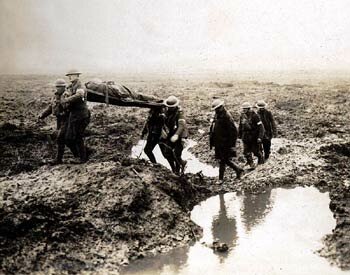
Did you know...?
That J.R.R. Tolkien's inspiration for the locale of the Dead Marshes Same and Frodo pass through is routed in history, both his personal history and the world's?
Tolkien lived through both world wars, though by the second one me was an old man. During the first, however, he was young and served in the army for his country.
If you know anything about WWI, you know how messy it was. The military strategy hadn't caught up to the technology, with the result that hundreds--perhaps thousands--of young men were needlessly killed. For years, warfare had consisted of digging trenches for cover, and running out of them for attacks. The problem was, WWI was the first major war that made use of things like machine guns and mustard gas. Given these weapons, the trench strategy was ludicrous! There was no advantage to it whatsoever and men on both sides were cut down without a prayer of life or victory. Many harsh lessons were learned during this war. It's one that even today fascinates and inspires because of the epic tragedy it engendered.
On the psychological side, things were even sadder. While war always does a number on soldiers, this one was particularly nasty for them. Not because it was any gorier than later wars, but because the soldiers were not prepared psychologically for what they would experience. I don't think anyone ever can be, but in our case today, we know what's out there. We have movies, the internet, the news, video games, books, etc that prepare us--at least somewhat--for what we might be facing should we choose to go to war. That was not so with these boys. Most of them were very honorable and went to war because they were loyal and nationalistic and wanted to fight for their country. It wasn't so much that those attitudes changed, but that they were utterly ignorant of what it would be like on the war front.
Enter a young J.R.R. Though it's hard to say what he felt about his experiences in WWI, what we know is that he made it out and lived a long, respectful life. Though he didn't know it in his lifetime, he wrote what would become one of the most famous, inspirational fantasy epics ever penned.
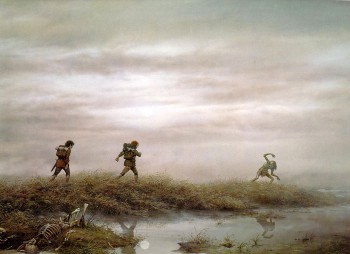
" 'They lie in all the pools, pale faces, deep deep under teh dark water. I saw them: grim faces and evil, noble faces and sad. Many faces proud and fair, and wees in their silver hair. But all foul, all rotting, all dead...'
'Yes, yes,' said Gollum. 'All dead, all rotton. Elves and Men and Orcs. The Dead Marshes. There was a great battle long ago...Tall men with long swords, and terrible Elves and Orcses shrieking. They fought on the plain for days and months at the Black Gates. But the Marshes have grown since then, swallowing up the graves; always creeping, creeping...You cannot reach them, you cannot touch them...Only shapes to see, perhaps, not to touch. No Precious! All dead.' "
What do you think?
Tuesday, May 8, 2012
Formulaic Fantasy

I was always mildly offended by this. (Or maybe not so mildly.) It seems to me that the only people who would seriously believe this to be true are those who've never actually read fantasy (enter Professor Pretentious). Of course there's your basic good vs evil conflicts, but they exist to a greater or lesser extent in every story and every genre. If not, your story SUCKS! (Or, you know, something less harsh than that.) Anyway, the only difference with scifi/fantasy is that the conflicts tend to be more tangible, but not preachy.
So how do you avoid writing formulaic stories, and is it really all that important?
While we writers should always strive to be creative and tell unique stories, I can't help but feel like the comment about fantasy being formulaic is the kind of excuse people use to bash on something they've never tried to understand. (Like the kind of thing people who've never heard a Garth Brooks song in their lives say about country music). While I'm all about everyone having their own opinions, most people who make these kinds of broad over-generalizations have never given the thing they're bashing on a chance to work on them. And (brace for a shock) most people who claim with a sniff that they don't like scifi/fantasy novels find that when they actually read one, they enjoy it in spite of themselves.
Truth be told, all fiction is somewhat formulaic by nature. If you write for any amount of time, it becomes clear that there are only so many types of conflicts that your characters can face. One obscure philosopher (maybe you've heard of him; his name was Aristotle) said there were only three: man vs man, man vs nature, man vs himself. Of course you can always bring emotional words into it like love, hope, courage, etc. No matter how many categories and subcategories you go with, there's still a finite number, so fiction by definition is somewhat formulaic.
So why do people continue to read new fiction (much less get excited about it) if all the conflicts have been explored before? Because we learn to avoid true formulaic fiction. The answer, it seems to me, is in the details. New and interesting characters, new angles on age-old conflicts, and a surprising twist every so often to give the reader a swift shock in the pants keeps them coming back for more. Let's use Katniss Everdeen as an example. The Hunger Games presents all three of the classic conflicts at various times, but we (as vicarious readers) are facing them in an unpredictable arena that terrifies us, from the point of view of a stubborn, independent girl whose family is on the line. Anyone who's ever felt protective of a younger sibling can identify with that, so we feel compassion for Katniss and want to see how it all turns out.
By exploring conflicts from different angles and the POVs of different kinds of people (i.e. characters) we continually better our understanding of the human experience. And there is nothing formulaic about that.
What are your thoughts?
Thursday, May 3, 2012
The Wheel of Time

The summer between my freshman and sophomore years of high school, I happened to be in the (now defunct) store Media Play. I went in several times over several weeks for various reasons, and I kept noticing a ginormous display of books. The picture on the front showed a young man on a horse at the head of a huge army. He had a crown on his head, banners at his back, and a sword pointed out in front of him toward something the picture didn't show. The book was entitled The Path of Daggers. I thought it looked like the coolest story EVER! When I picked it up to look closer, I noticed a small caption in the corner that read "Book 8 of The Wheel of Time."
Book 8?! I thought. What the...
I went to the scifi/fantasy section and found book 1. I figured it couldn't hurt to try it out. And the rest, as they say, is history. I read the first two books in under two weeks. Then school started and I was pissed that I could no longer sit around reading all day every day. By the time I'd read the first seven books, the eighth had come out in paperback, which, being a poor 17-year-old, made me very happy. But after that I was "caught up" and had to wait 1-2 years in between each installment. Dah! What misery!
And then came the day when I heard the tragic news that the beloved Robert Jordan had lost his battle with terminal illness. I remember feeling sick. Brandon Sanderson stepped in to finish the series, lucky for us. No matter what you think of Sanderson's writing style or how well he's done, it was a monumental undertaking and I think he's done quite well, all things considered. His style isn't Jordan's but for me, it's more important to finally finish something I started more than a decade ago than to nitpick about how different the narrative details are.
This post is getting long, but in a nut shell I must say that Robert Jordan may have done more to influence me as a writer than any other single person or force. I couldn't stop reading this series and I always wanted to write something that someone, somewhere would love even half that much.
His characters were well rounded and oh so human. You couldn't help but route for them. (In the case of the Forsaken and Darkfriends you were routing for their opportunity to be kissed by balefire, but still.) He loved his irony, his tragedy, and his embroidery descriptions. (Don't get me started).
Subscribe to:
Posts
(
Atom
)