
Author Liesel K. Hill's Musings on Fantasia...
Showing posts with label Writing How-To. Show all posts
Showing posts with label Writing How-To. Show all posts
Monday, January 15, 2018
Ax Those Crutch Words: BUT

Picture Source
Good morning, lovely readers! Welcome to my series on crutch words and passive voice, as I know this is something we all struggle with.
If you've ever read your writing and thought it sounded sub-par or unprofessional, but just didn't know how to fix it, chances are you're leaning on crutch words or using passive voice. I'll show you how to fix that.
The truth is that writers don't have enough of a science behind fixing this sort of thing. Sure, most of the really great writers out there stay away from crutch words and passive voice, but most of that is instinctual for them, after a lot of hours of writing and learning and honing.
Even most other authors you'll find may be able to tell you that something is lacking in your writing, but even they may not know exactly what it is or how to fix it. Or even if they can pinpoint it, it's hard for them (for any of us) to give actual, definable steps toward fixing our weak writing.
Saying, "Do it better," really doesn't help much. Especially newbie writers who really want to write better, but simply don't know how.
Here's where I'll start giving tips to help you out with this. Because there are many MANY offenders when it comes to crutch words, and they nearly always lead to passive voice. So if you cut out your crutch words, 99% of the passive voice in your writing automatically goes away. Isn't that amazing? And you get the added benefit of tighter, more grounded writing. The kind readers love to read and publishers love to publish.
Today's offender: BUT
|
| Picture Source |
Good morning, lovely readers! Welcome to my series on crutch words and passive voice, as I know this is something we all struggle with.
"She wanted to help, but didn't know how."
I use this format in my writing a lot. I compare two things and separate the clauses with the word
"but." It's certainly not a bad thing. Especially if you don't do it
and need a way to change up your sentence structure, try it. But (hehe) I do it
too much. I also start too many
sentences with the word "But."
So for this, I go through and read each "but." If
I can separate the two clauses into two sentences without changing the meaning,
I do. If the "but" must be there, and I can't find any other way to say what I
want, then I leave it. Again, I find I can always get rid of most instances of
this without changing the story at all. At least, I can easily get down to the
1% rule.
Example 1: It felt cowardly, but confronting him would have
to wait.
The Fix: It felt cowardly. Yet
confronting him would have to wait.
Example 2: He needed to
get in line, but tied his shoe first.
The Fix: He needed to
get in line. He tied his shoe first.
(Of course, you should change up your sentence structure
here as well, so it doesn’t feel so repetitive. You get my drift, though.)
Last Resort Synonyms:
1. And - "But" should
only be used if differentiating something. Showing how something is different
than what you said in the first clause. Often it's interchangeable with
"and."
Example 1: He went to
the store but couldn't find what he needed.
The Fix: He went to the
store and couldn't find what he needed.
2. Except - This works in a case where
"but" is being used to show a remnant of something.
Example 2: He took all
the cookies but one.
The Fix: He took all the
cookies except one.
Again, these are "last resort" because you're
substituting one filler word for another, even if the one you swap for isn't a
crutch for you. Use with caution.

Check out Ax Those Crutch Words: Part 1: Was and Part 2: Had.
Also, check out my other books at: www.authorlkhill.com.
How about you? Is HAD a culprit in your writing?

Friday, January 5, 2018
Writing Advice NOT to Heed: Strong Female Characters
Lately I've been thinking about all the advice newbie writers are given. Some of it is good. Other pieces are great. But as is the case when learning any craft or industry, you end up getting a lot of advice that simply isn't worth heeding. Of course you often don't know it until years later.
 When I was shopping around my first book, Citadels of Fire, to traditional publishers, what I heard over and over again was that I needed a strong female character and to sell the book, I needed to capitalize on her strengths in the description.
The problem with that is that my female character, Inga, isn't what most people would consider traditionally strong. In fact, I sort of wrote her to be weak in the beginning so the audience could see the dynamic change in her over the course of the trilogy. Even though I thought she was a compelling character, I couldn't think of any particular strengths she had that I could capitalize on, so I had a hard time selling the story to traditional publishers and agents.
Part of the problem was being so new and not understanding how to frame my story in a way that readers and others in the industry can latch on to. That's a skill that comes over time
But my point is that if you listened to traditional publishing advice, it starts to sound like every story must contain a tough-as-nails, leather-wearing, Laura-Croft-type kickass character or the story won't sell.
That's simply not true.
I'd venture to guess that any character you write will have strengths. They just may not be the traditionally "strong" female characters that the industry likes to rave about. Anything can be a strength. Even things that are low key. Look at Jane Eyre. On the surface, she appeared quite plain and boring to most people, but she's one of the most beloved female characters of all time. Decide what your character's strengths are and play them up. A lot. Just don't assume they have to fit into any particular mould.
And don't get me wrong: kickass characters are great and they do tend to be fan favorites. But there are other fish in the sea. And there's a lot to be said for starting your character off in a place of weakness and letting your audience watch her/him grow. My audience has connected with Inga in a way that has pleased me immensely. They love her because they can see her growing stronger from one book to the next.
I'm gonna go out on a limb here (sarcasm) and say that it's less important for your character, male or female, to be "strong" (what's the definition on that anyway; it's a total umbrella term) than to be relatable. It's the characters unique traits that will connect your audience to them.
Let's take a look at a couple of character examples who tend to be fan favorites: Hermione Granger and Ron Weasley.
Hermione definitely kicked butt with her spells various times over the series, but she wasn't exactly a leather-wearing martial arts expert. Her strength was in her goodness and her academic smarts. She wasn't strong in a physical or conventional sense, but because everyone either knew a girl like her, or WAS a girl like her during their school days, she's very relatable.
And how about Ron? He doesn't have any tangible qualities to point to. He's your average every-boy. His strengths are in the non-tangible: humility, kindness, and loyalty to his friends and family. But because he's just so human and boyish, he's someone every single one of us can relate to.
See what I mean? So pick your characters' major traits (the less like other characters, the better, in my opinion) and just bring them across in a strong way.
Ignore the hype that suggests every successful story must have a strong female character, a vampire or werewolf, an exotic setting and a pornographic love scene. Because if that's all we had to read, well...that would be awful. ;D
How do YOU bring across strength in your characters?

The problem with that is that my female character, Inga, isn't what most people would consider traditionally strong. In fact, I sort of wrote her to be weak in the beginning so the audience could see the dynamic change in her over the course of the trilogy. Even though I thought she was a compelling character, I couldn't think of any particular strengths she had that I could capitalize on, so I had a hard time selling the story to traditional publishers and agents.
Part of the problem was being so new and not understanding how to frame my story in a way that readers and others in the industry can latch on to. That's a skill that comes over time
But my point is that if you listened to traditional publishing advice, it starts to sound like every story must contain a tough-as-nails, leather-wearing, Laura-Croft-type kickass character or the story won't sell.
That's simply not true.
I'd venture to guess that any character you write will have strengths. They just may not be the traditionally "strong" female characters that the industry likes to rave about. Anything can be a strength. Even things that are low key. Look at Jane Eyre. On the surface, she appeared quite plain and boring to most people, but she's one of the most beloved female characters of all time. Decide what your character's strengths are and play them up. A lot. Just don't assume they have to fit into any particular mould.
And don't get me wrong: kickass characters are great and they do tend to be fan favorites. But there are other fish in the sea. And there's a lot to be said for starting your character off in a place of weakness and letting your audience watch her/him grow. My audience has connected with Inga in a way that has pleased me immensely. They love her because they can see her growing stronger from one book to the next.
I'm gonna go out on a limb here (sarcasm) and say that it's less important for your character, male or female, to be "strong" (what's the definition on that anyway; it's a total umbrella term) than to be relatable. It's the characters unique traits that will connect your audience to them.
Let's take a look at a couple of character examples who tend to be fan favorites: Hermione Granger and Ron Weasley.
 |
| Source |
Hermione definitely kicked butt with her spells various times over the series, but she wasn't exactly a leather-wearing martial arts expert. Her strength was in her goodness and her academic smarts. She wasn't strong in a physical or conventional sense, but because everyone either knew a girl like her, or WAS a girl like her during their school days, she's very relatable.
And how about Ron? He doesn't have any tangible qualities to point to. He's your average every-boy. His strengths are in the non-tangible: humility, kindness, and loyalty to his friends and family. But because he's just so human and boyish, he's someone every single one of us can relate to.
See what I mean? So pick your characters' major traits (the less like other characters, the better, in my opinion) and just bring them across in a strong way.
Ignore the hype that suggests every successful story must have a strong female character, a vampire or werewolf, an exotic setting and a pornographic love scene. Because if that's all we had to read, well...that would be awful. ;D
How do YOU bring across strength in your characters?
Tuesday, January 2, 2018
Ax Those Crutch Words: HAD
 |
| Source |
If you've ever read your writing and thought it sounded sub-par or unprofessional, but just didn't know how to fix it, chances are you're leaning on crutch words or using passive voice. I'll show you how to fix that.
The truth is that writers don't have enough of a science behind fixing this sort of thing. Sure, most of the really great writers out there stay away from crutch words and passive voice, but most of that is instinctual for them, after a lot of hours of writing and learning and honing.
Even most other authors you'll find may be able to tell you that something is lacking in your writing, but even they may not know exactly what it is or how to fix it. Or even if they can pinpoint it, it's hard for them (for any of us) to give actual, definable steps toward fixing our weak writing.
Saying, "Do it better," really doesn't help much. Especially newbie writers who really want to write better, but simply don't know how.
Here's where I'll start giving tips to help you out with this. Because there are many MANY offenders when it comes to crutch words, and they nearly always lead to passive voice. So if you cut out your crutch words, 99% of the passive voice in your writing automatically goes away. Isn't that amazing? And you get the added benefit of tighter, more grounded writing. The kind readers love to read and publishers love to publish.
Today's offender: HAD
1. Get rid of multiple past tense instances. "Had" shows up the most when you're
writing in past tense. "She had gone downstairs to find her shoes."
The thing is, you only need one instance of "had" to show you're
talking about something from the past. After the first instance, you can use
regular past tense. Observe the difference:
"She had
gone downstairs to look for her shoes. She had
gone into the bathroom. They weren't there. She had
then gone into her room, and had searched
every nook and cranny. Not finding them, she had
gone back upstairs to search the living room."
See how many "hads" there are? It becomes a
headache. Now let's take out those crutch words, leaving in only the first
instance to establish past tense.
"She had gone downstairs to look for her shoes. She
searched in the bathroom. They weren't there. She went into her room, searching
every nook and cranny. Not finding them, she went back upstairs to search the
living room."
See the difference?
2. Cut Filler. If
it makes sense without the "had," get rid of it. If the sentence only
makes sense with the had, then obviously keep it. I find that 50% of my hads
are filler and can be cut without affecting the sentence in the least.
Example 1: “Who’s Gabe?”
Jane had
demanded.
The Fix: “Who’s Gabe?”
Jane demanded.
Example 2: The phone
screen had
shown the number clearly.
The Fix: The phone
screen showed the number clearly.
Example 3: She had not
gotten any groceries.
The Fix: She didn't get
any groceries.
Example 4: He had come
to see the game.
The Fix: He came to see
the game.
Example 5: They had to
be mistaken.
The Fix: They must be
mistaken.
Example 6: She'd had to
learn the spell.
The Fix: She'd learned
the spell.
Check out my other books at: www.authorlkhill.com.
How about you? Is HAD a culprit in your writing?
Wednesday, January 18, 2017
Why Authors Should Read Motivational Books
 |
| Source |
So right now I'm reading Brendon Burchard's The Charge and I'm loving it. It's fantastic. So inspirational! And it's meant to be. It's motivational book, after all. But that's not why I'm advising authors to read books like this.
 |
| Picture Source |
Let's talk about THEME for a minute. All stories we write have themes, yeah? Part of our craft is learning to incorporate theme into plot so that it's a natural part of the story. So we aren't telling or sounding to preachy. But sometimes, it can be a challenge to figure out what theme we're going for in a story.
A story that meanders along and needs help probably doesn't have a concrete theme. Once the author figures out the theme, the entire story comes together. And this doesn't always happen by the author having a light bulb moment about "theme." Sometimes by figuring out events in the plot, things fall into place. But chances are those events complete a theme the author didn't even know they were aiming for. It's a beautiful thing when that happens.
So what's that got to do with motivational books or my current read?
Well, it's been a while since I read a motivational book. Probably about a year. But I've been annotating the crap out of this book. So many of the statements in it have jumped out at me as relevant to my WIPs. I've thought a lot about why that is. Some of the topics covered by author include how to train our brains to be motivated and follow through on our goals and aspirations. He talks about mechanisms in the brain that are keeping us from doing that.
"Emotion, it turns out, is the spark that compels us to care in the first place."--Brendon Burchard, The Charge, pg 100.
Since my Interchron series is all about the brain and how it connects to the soul, obviously this is going to strike a chord with me.
But that's not all that's jumped out at me. Other things have struck me as relevant to other novels, including my crime fiction series and the high fantasy/dragon series that I'm still working on and haven't started publishing yet. So it can't just be a matter of something being specific to me and oh what great luck that I picked this book up. It's more than that.
Finally, the other day, it hit me: General, true, motivational statements are inherent themes.
"Our desire to bond and belong outweighs almost every other desire--often even our desire for survival..."--Brendon Burchard, The Charge, pg. 117
Let's take a really vague and obvious example like "You should always put your children first." Now, again, if you have your characters say this a million times, or point it out in the narrative a bunch of times, that will come off as preachy and it's obvious the author is trying to tell their audience something. A great writer will create a story with flawed characters and show this theme. Make the audience really feel it. Maybe even show the negative consequences of when this isn't done.
But you all know that. It's the definition of great story-telling, right?

My point is that motivational statements, by definition, are themes. Not every motivation statement you read will be applicable to your WIP by far, but some will. They can help you come up with theme, which can only help you craft your story more effectively. So if this is something you're struggling with, pick up a motivational book.
"There is a bolder man inside you than the one sitting next to me now."--Brendon Burchard, The Charge, pg. 145.
My personal and of course very objective suggestion would be The Charge. ;D
Do you struggle with theme? How do you push through to define it? What's your favorite motivational book?
Friday, September 9, 2016
2 Techniques for Coming Up With Premises
 |
| Source |
So about a week ago, I had a friend ask me how I come up with story ideas. This is a friend I talk to often and so she knows I always have way more stories in my head than I actually get around to writing. So her question was really more about how I can come up with so many things that can potentially turn into books. We also briefly discussed how to fill out a plot.
For me, it's not very different from coming up with full premises. I have ideas for certain things--often they're situations without full stories attached, or lines of dialogue I think are awesome and want to incorporate. There are hundreds of these little nuggets floating around in my head or in various untidy notebooks that litter my work space. So when I need to round out a plot or character, I often draw on these little idea. Generally I have to find some way to mold them to the story I'm already telling, which can change them a lot from what I had in mind at their inception. But I'll tell you, lovely readers, this is often where the magic happens.
So how to come up with these premises or little idea nuggets? In my mind, there are two major ways to do it. Either on purpose (sort of forcing it, if you will) or just paying attention to the things that you find interesting. Let me explain.
1. On Purpose - I talked about this a lot in THIS POST and it's a technique I learned from the wonderful Clint Johnson. I know from my description above about forcing it, many people will balk. But I don't mean "forcing it" in the sense you're probably thinking. This is really just about being creative on purpose.
 |
| My prowling wolf painting. |
You'll find once you get started that you can go until your hand cramps (or your kids jump on you, your alarm goes off, whatever yanks you unceremoniously out of the Zone). It's such a great exercise for getting the creative juices flowing. Even if what you come up with in any given session doesn't turn into a best-selling novel, you can still come up with nuggets to sprinkle into your writing. Fill in gaps. And occasionally round out stories that win Pulitzer Prizes. (Disclaimer: Have I ever used this technique to win a Pulizter?...No. Other awards yes, but the Pulitzer no. ;D)
 |
| (Blurred some plot stuff out. ;D) |
So my friend asked me to give her an example of something I thought was interesting that might turn into a story. Well, I think most of my books have at least something that would qualify, but the example I gave her has to do with a book I'm currently reading and a story I'm not actually writing at present.
As most of you who follow me know, I'm just a little bit fascinated by serial killers.
 |
| Just a little bit. ;D Source |
Some time ago--I'm not even sure when or where I first heard it--I learned a little something about the Butcher of Kingsbury Run. He was a prolific serial killer in Cleveland, Ohio in the '30s. The book I'm reading is a non-fiction about the case (In the Wake of the Butcher by James Jessen Badal). But I'm honestly not interested in the Butcher solely bc he was a serial killer (I've read about tons of those) or even because he was never caught (though that does up the interest factor a bit). What REALLY made me interested in the case was finding out that Eliot Ness--yes THE Eliot Ness who brought down Capone and founded the Untouchables--presided over the case. And this was years after his success with the Chicago mob.
Ness was known for being traditional to a fault, extremely moral, and unrelenting in both his strictness and effectiveness at rooting out police corruption. So what would a man like that do with a case that involved an elusive serial killer? How would he handle body parts bobbing in the river every few months, and not being able to stop it. A case like this isn't something you can control or predict. I think it would be an interesting character sketch to explore how a man like Ness (ladybug to Capone's aphid) would react to a situation like that. And then there's the fact that it was never solved. Unlike in Chicago, Ness never got his man.
THAT'S the kind of stuff that fascinates me. THAT's the kind of stuff I want to learn and write about.
Now, chances are EVENTUALLY some piece of writing will come from my research on this, but I have a lot more to do, especially on Ness himself. (The book I'm reading is really more about the facts of the case.) But the point is, I just read a single line about how Eliot Ness eventually presided over the Butcher case and went, "Huh. That's kind of interesting." Boom. A story is born. Don't underestimate the power of tiny tidbits that catch your attention for a few seconds. Write them down, or you'll never know the potential they could have had.
So, what techniques do YOU use to come up with story premises or fill out already-existing plots?
Monday, August 22, 2016
3 Ways Poetry Can Enhance Your Novel
 |
| Source |
I know, right? I'm as shocked as you are. I've never been much of a poet. I mean, I rhyme couplets with the best of them, don't get me wrong. But I took a poetry class in college, thinking it'd be a breeze for me, and found out I sucked.
And granted, that was a college level poetic forms class. Really what I discovered is that I hate conforming to rigid rules in my writing. Some people flourish. I just feel like it stifles my creativity. There are certain genres I don't write for the same reason.
As with anything in life, if I really wanted to be good at poetry--form or otherwise--and I put my mind to it, applied myself, practiced, I could become good at it. I don't have the drive or patience. Basically, I just don't wanna.
But lately I've noticed several different works that have used some kind of poetry--poems, songs, prophecies, if we're talking high fantasy--that really enhance the story.
 |
| Source |
Do not go gentle into that good night,
Old age should burn and rave at close of day;
Rage, rage against the dying of the light.
Something about the juxtaposition of those two things was just so compelling. The first time I watched that film was on a small screen with a terrible internet connection, but I was still completely entranced by it.
So why does adding poetry, lyrics, limericks, etc work so well when they're done correctly?
1. It can be used as a contrast. It's hard to show high-action drama but also bring across a calm, emotional theme. If you stop in the middle of your action scene to philosophize about theme, it's gonna kill your story. Editors will gleefully take a red pen to that crap. But using poetry accomplishes both at the same time. (Okay, it's harder to do it at the exact same form in book format than in film form, but you get the idea. It's easier to insert a few lines of poetry in an action scene without disrupting the flow of action. Or you can put it right after the scene to reinforce the theme you wanted to get across without being preachy or "telling" your reader something.)
2. It can bring theme across in a more obvious way. Building on #1, you may have a theme you want to bring across, but of course you can't just tell the reader what it is. This is a great way to actually put the theme into the story in a more-obvious way. Some writers may feel that this isn't subtle enough, but I think if done correctly, it can be very powerful.
3. Reinforcement. I keep mentioning theme, but you can use poetry to reinforce anything. Character arcs, symbols, conflicts, foreshadowing. Anything you want. In short, it's another tool writers can use to help not only tell their story, but bring it across in a powerful way.
I've already started employing this method in my WIP, which is a high fantasy. It kind of opens up a whole new world of exciting possibilities.
Have you used poetry, lyrics or something similar in any of your stories? How did it go for you?
Wednesday, July 13, 2016
32 Crutch Words to Slice and Dice from Your Writing
 |
| Source |
So, what is a crutch word, you ask?
It's a word (phrases count too) that any given author uses a lot. Too much, really. We use them in everyday speech as well. Words like, "like," "to be honest," "actually," etc. They're words and phrases that are used so often as crutches or place holders, that they really don't mean anything at all anymore.
And while they probably aren't AS meaningless in your writing as they are in our everyday speech, what it really comes down to is that they don't add anything in the sentence. And that's my rule of thumb while editing: if I can cut the word and the sentence still makes sense, then I do.
There are exceptions of course, especially with particular character dialogue. Maybe you want them to over-talk so sound less educated or as part of their character. Totally cool if you do. As always, cutting these words is the author's choice.
So I've made it a habit, now, when I'm editing a chapter, to edit for crutch words. The easiest way I've found is to use Word's "Find" function (or whatever program and search function you use) to find and change them on a case by case basis.
Is it tedious? Yeah, definitely. But as with all things, it just takes practice. At first it will feel like the embodiment of why hell is full of unedited first drafts, but I've gotten to a point where I can do it quite cheerfully.
And how do I pull that off? Because like all editing, it's a way to make my writing better, stronger, and more readable. And I enjoy that. Not only that, but you know the rule about writing a first draft and then tightening/cutting by 10%? Editing for crutch words will often do that for you automatically. I'll give examples below so you can see.
 |
| Source |
All right. So here is my list of crutch words. Yes, I really do edit every chapter for every one of these. But I'm getting better at it. Once you start noticing and editing for them, you'll unconsciously use them less in your writing, which will make the editing easier anyway. Also, remember that while these will apply to MANY writers out there, each writer has their own unique crutch words as well. So maybe some of these don't apply to you. And probably you have a few that don't apply to me. Isn't variation wonderful!?! ;D
Crutch Words to Edit For:
Because they're used WAY too often and we need to find stronger ways to describe things. Also to stay away from passive voice (was walking, were talking, etc.):
- was
- but
- were
- that
- had
Because 99%+ of the time, you can cut them and your writing will be stronger by leaps and bounds (these are the ones that usually mean absolutely nothing in the sentence):
- just
- really
- especially
- suddenly
- finally
- a bit
- for a moment
- very
- even
- might
- looked
- almost
- probably
Because in writing, you either do something or you don't do it. Something is or it isn't. No half-measures:
- seemed
- began/started
- tried/managed
To avoid telling:
- looked
- realized
- knew
- saw
- heard
- smelled
- tasted
- felt
Also look out for
- reflexives: "my own," "himself," "herself," "itself,"etc.
- transitional overuses: "then," "and" or "but" at the beginning or in the middle of sentences, etc.
- prepositional phrases, especially at the beginning of sentences; they tend to convey information you've already conveyed elsewhere: "before the concert..." "on the way to the market..." "while she brushed her teeth..."
I know this is a lot, but if you get in the habit of editing your crutch words, your writing will be MUCH stronger. It also gives you a great deal of self-awareness as a writer, which is empowering. And that can only be a good thing. ;D
What are YOUR crutch words?
Sunday, February 28, 2016
Good Monday morning! I hope everyone had a safe and fun weekend. Mine was stupendous! (;D)
So I'm kinda cheating today because I'm just putting up a picture, but I honestly think these twelve rules are very valuable and should be taken into consideration by every author. I definitely learned something reading them!
So read and consider. Then apply to your writing! And have a fabulous week!
Which of these rules is your favorite? Is there one you plan to start using?
So I'm kinda cheating today because I'm just putting up a picture, but I honestly think these twelve rules are very valuable and should be taken into consideration by every author. I definitely learned something reading them!
So read and consider. Then apply to your writing! And have a fabulous week!
 |
| Source |
Monday, February 15, 2016
4 Tips for Writing Unforgettable Argument Scenes
 |
| Pride and Prejudice epic argument (Pic Source) |
You wouldn't think we as readers would enjoy that, as most of don't enjoy engaging in those kinds of fights in real life. But story telling is different. These scenes, when done well, are the height of conflict. They're the height of the characters' passionate emotions and beliefs about something. They get our adrenaline pumping and make us excited to turn pages.
In terms of masterful story telling, it can hash out conflict in a visceral way, give us the characters' points of view and beliefs in their own words (with the added bonus of intense emotion) and push them toward the next phase in their development, or the next turn in the story.
**Bonus tip: If you get stuck and don't know how the characters or the plot from A to B, consider a visceral, verbal, knock-down, drag-out scream fight. Even if you don't end up using it in the story, it'll do wonders for your creative juices.**
But how do we write these kinds of arguments? How do we make them really jump off the page and grip our readers by the guts?
 |
| Rocky III epic argument (Pic Source) |
Monday, February 8, 2016
Pixar's 22 Rules of Storytelling
 |
| Gif Source |
This is going up a bit late today, but what can I say? Super Bowl Sunday means that, naturally, I'm gonna get less done than usual. :D (How did everyone like the game, btw?)
So I cam across these rules a while ago, courtesy of Pinterest, and I thought they had a lot of depth and value to them, so I thought I'd share them. And actually I'd say they're less rules and more like 22 pieces of writing advice from a very successful story-telling company. Keep in mind these are applied to mostly children's cartoons, but each and every one can be adapted for writing novels or any other kind of story you may be working on. My commentary is in the blue font. (Obviously, as they're from Pixar, I didn't make them up myself. Just for the record.)
1. Admire characters for attempting more than what their successes have been. Push them. Give them challenges.
2. Keep in mind what's interesting to you as an audience, not what's fun to do as a writer. They can be very different.
3. Trying for theme is important, however you won't see what the story is about until you're at the end of the story. Got it? Now rewrite. I personally don't think there's anything wrong with trying for a particular theme, but don't force it. If you let the story and characters take you where they want to go, the theme will emerge naturally. And it may not be the theme you were originally trying for, which is often kinda cool.
4. Once upon a time there was ___. Every day___. One day__.Because of that___. Because of that___. Until finally___.
5. Simplify. Focus. Combine characters. Hop over detours. You'll feel like you're losing valuable stuff, but it sets you free. In other words, tighten, tighten, tighten.
Monday, January 25, 2016
9 Ways to Improve Character Relationships
 |
| Source |
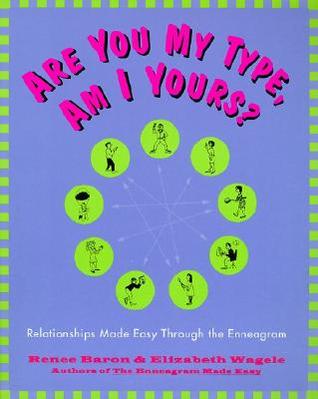
It's entitled Are You My Type, Am I Yours? by Renee Baron & Elizabeth Wagele.
I've picked it up several times since then but only finally got around to reading it recently. Basically this book talks about the 9 types of personality, how they interact, what their motivations are, and what types get along vs. what types don't. So you can use them in friendships of course, but it also shows what personality type each type usually chooses in a partner, and what they value vs. what annoys them in each of the other types. So you can use this to write realistic personalities for each individual character, but then can also contrast various personalities to come up with realistic personality clashes. (How many of us could do that off the top of our heads?)
This book is incredibly useful and fun to read on many levels. Not only will you find yourself figuring out what type all the people in your life are, but you'll also start assigning types to various characters, whether they're the ones you've written or just others in your favorite books and TV shows.
The book also has a section on the 16 MBTI personality types, and then shows an intersection between that and the 9 named in the Enneagram.
So I'll go over these briefly, but to get a truly rounded picture, I would highly recommend reading (and buying so you can refer back to it as you write various characters) the book for yourself.
*Abbrieviations: WoT = Wheel of Time, TWD = The Walking Dead, AToTC = A Tale of Two Cities, GoT = Game of Thrones, LOTR = Lord of the Rings. (Sorry if you don't know the references. I stuck to people and characters that first jumped to mind when I read the book, or were put forth by the book itself. :D)*
Personality Types: Motivated by: Examples:
1. The Perfectionist The need to improve themselves Nynaeve al'Meara (WoT)
and live the right way. Javere (Les Miserables)
2. The Helper The need to be loved and valued Mother Theresa
and express their love for others Beth Greene (TWD)
3. The Achiever The need to be well-regarded, Steve Jobs
successful, productive, efficient. Perrin Aybarra (WoT)
Tyrion Lannister (GoT)
4. The Romantic The need to understand their MANY writers, actors, &
feelings, search for what is artists fall into this
missing, what life means, and category.
avoid being ordinary.
5. The Observer The need to know & understand, Daryl Dixon (TWD)
be self-sufficient, and not feel Sydney Carton (AToTC)
engulfed or invaded.
6. The Questioner The need for security. (Asks Anna Karenina
what-if questions, often negative Sansa Stark (GoT)
ones ie. what if something goes
wrong?)
7. The Adventurer The need to be happy, contribute Arya Stark (GoT)
to the world, and avoid pain. Matrim Cauthon (WoT)
8. The Asserter The need to be self-reliant, Will Smith
strong, and make an impact JD Rockefeller
on the world.
9.The Peacemaker The need to live in harmony, to Jimmy Stewart, Abe Lincoln
merge with others and avoid Samwise Gamgee (LOTR)
conflict. Loial (WoT)
So this is really just an overview. If you want to create REALLY realistic interactions between all of your characters, I highly recommend studying this book. I already have big plans for what I've learned.
How do you take on the challenge of creating realistic personalities for your characters?
Subscribe to:
Posts
(
Atom
)